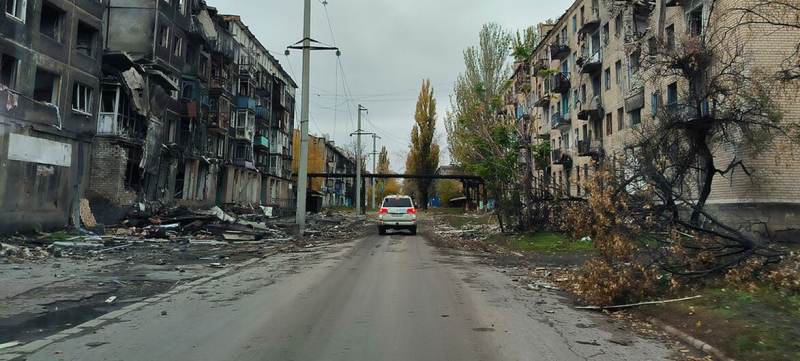

A UN vehicle drives through a Ukrainian city damaged by shelling. Updated estimate: Ukraine will need nearly $588 billion to rebuild Peace and security
Four years after the outbreak of full-scale war, rebuilding Ukraine over the next decade will require almost $588 billion (more than €500 billion). This is stated in an updated joint damage and needs assessment prepared by the Ukrainian government, the World Bank, the European Commission and the United Nations. This amount is almost three times the country’s projected nominal GDP for 2025.
With the support of international partners, Ukrainian authorities are already planning priority restoration projects for 2026. We are talking about government investments and key assistance programs – restoring destroyed housing, demining and supporting the economy – amounting to more than $15 billion. In addition, rapid repair efforts and recovery programs have already provided at least $20 billion since February 2022 for projects in housing, energy, education, transportation and other critical services.
We are still able to quickly recover and move forward. I thank the teams at the World Bank, EU and UN for supporting our efforts
“Four years after Russia’s full-scale invasion, the total cost of recovery and reconstruction for Ukraine is now estimated at nearly $588 billion over the next decade—nearly three times the country’s projected nominal GDP for 2025,” said Ukrainian Prime Minister Yulia Sviridenko. “Despite unprecedented Russian attacks this winter on energy infrastructure and residential buildings across Ukraine, our people are demonstrating resilience and entrepreneurs continue to work. We are still able to recover quickly and move forward. I thank the teams at the World Bank, EU and UN for supporting our efforts. This assistance allows for urgent repairs of critical infrastructure and continued systemic recovery, with a particular focus on energy and housing.”
The report covers the period from February 2022 to December 2025 – almost four years of war. According to him, direct damage has already exceeded $195 billion (166 billion euros), while a year earlier the estimate was $176 billion. The hardest hit sectors were housing, transport and energy, especially in frontline regions and large cities.
Energy infrastructure continues to come under intense attack, with the number of damaged or destroyed assets up about 21 percent from the previous estimate. In the transport sector, demands have increased by about 24 percent due to impacts on railways and ports in 2025. As of the end of 2025, 14 percent of the country’s housing stock was damaged or destroyed—more than three million households.
“Despite the widespread destruction that continues to wreak havoc on Ukraine’s people, economy and infrastructure, the entire country is demonstrating extraordinary resilience and determination,” said World Bank Managing Director for Operations Anna Bjerde. “The World Bank Group is firmly committed to supporting Ukraine’s recovery, helping to create jobs, opportunity and hope in a resilient, modern and competitive economy.”
The report’s authors note that the private sector will play an important role in the recovery. However, to attract investment, further reforms are needed – improving the business climate, expanding access to finance and adapting the economy to the environmental and digital standards of the European Union.
The return of refugees, the reintegration of veterans and the participation of women in the labor market will determine economic recovery as much as investment and infrastructure rebuilding
“Russia’s war of aggression continues to have a devastating impact on Ukraine,” said EU Commissioner for Enlargement Martha Kos. “The EU will continue to play a key role in supporting Ukraine’s recovery, mobilizing private investment through the Ukraine Investment Framework and driving reforms under the Ukraine Plan that will help attract investment and bring the country closer to EU membership.”
The largest long-term costs are associated with the transport sector – more than $96 billion. This is followed by energy (almost $91 billion), housing (almost $90 billion), trade and industry (more than $63 billion) and agriculture (more than $55 billion). Almost $28 billion will be needed to clear mines and debris.
“Recovery efforts are focused on people. Ukraine’s main resource is its population. The return of refugees, the reintegration of veterans, and the participation of women in the labor market will shape economic recovery as much as investment and infrastructure rebuilding. Recovery must be people- and community-centered,” says UN Coordinator Matthias Schmale.
The report also emphasizes that the country’s future economic strategy – “Ukraine’s Future Economy” – is aimed at macro-financial stability, governance reforms, private sector development, infrastructure restoration and investment in human capital, which should strengthen investor confidence and accelerate Ukraine’s rapprochement with the European Union.