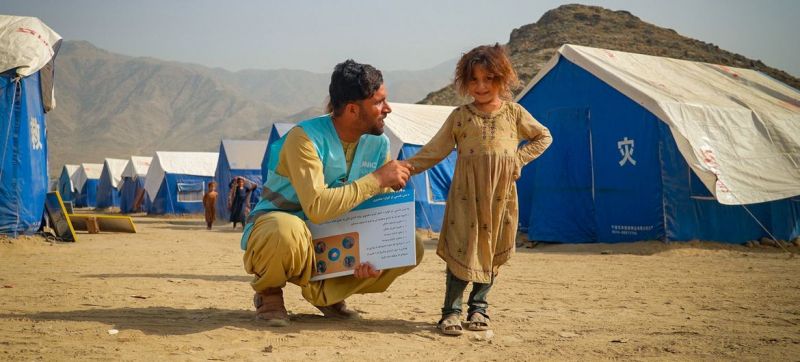

An aid worker talks to a young girl who lives in a camp for displaced people in Afghanistan, close to the Pakistan border. UN’s Türk urges dialogue after deadly clashes on Afghan-Pakistan border By Daniel Johnson Human Rights
UN human rights chief Volker Türk on Thursday appealed for dialogue between Afghanistan and Pakistan amid border clashes and deadly airstrikes, while condemning ever harsher “apartheid” edicts issued by the Afghan de facto authorities that continue to severely impact women and girls.
“This situation calls for urgent political dialogue, rather than escalating the use of force,” said the High Commissioner for Human Rights, following a sharp increase in civilian casualties in cross-border clashes with Pakistani military forces, who have been reported targeting armed militants sheltering in Afghanistan.
According to the UN Mission in Afghanistan, UNAMA, 70 civilians were killed and 478 were injured in Afghanistan in the last three months of 2025. “There were further casualties earlier this week, when 13 civilians were killed and several more injured following airstrikes by Pakistani forces,” Mr. Türk said.
Deadly decrees
The latest batch of Taliban decrees since the group overran Kabul in 2021 increases the number of crimes punishable by death and allows women and children to be beaten in their homes.
Criticism of the authorities is also a criminal offense and the overriding conclusion is that Afghanistan is now “a graveyard for human rights”, Mr. Türk told the Human Rights Council in Geneva, the UN’s top human rights forum.
“The system of segregation is reminiscent of apartheid, based on gender rather than race,” he said. The de facto authorities have, in effect, criminalized the presence of women and girls in public life. They are banned from secondary education and above, and from most employment. Discrimination affects their healthcare, their access to civic space, and their freedom of movement and expression.”
Veiled threat
As an indication of the increasingly pervasive controls and repression that Afghan people now endure in their daily lives, the High Commissioner described how vice legislation is used to ensure that men grow beards and that women wear the hijab in line with strict rules.
The “Law on the Propagation of Virtue and Prevention of Vice” is also being employed to enforce the rule that women only leave their homes with a male guardian, while also banning music and images of living beings.
Since 7 September last year, the de facto authorities have prevented Afghan women, including UN staff, contractors and visitors, from entering UN premises across the country. “These restrictions are unprecedented and deeply disturbing,” Mr. Türk said, as he supported the international community “to put pressure on the de facto authorities” so that they respect their international human rights obligations.
“In Afghanistan and elsewhere, human rights violations and abuses have serious implications for peace and security,” the High Commissioner insisted, before adding that his Office will continue “documenting and recording the violations and abuses that have taken place in Afghanistan.”
The desperate and deteriorating situation for the people of Afghanistan has been a major and longstanding concern of the global community. In addition to the Human Rights Council which gives a voice to the country’s people, the situation is regularly addressed at UN Security Council debates where sanctions have been applied, among other measures, including monitoring.
The UN General Assembly is also fully engaged on Afghanistan and has passed resolutions expressing continuing support for the Afghan people and a “stable, secure and economically self-sufficient State free of terrorism, illicit narcotics, transnational organized crime and corruption.”
Beyond the global body, the UN-backed International Criminal Court (ICC) has issued arrest warrants for the Supreme Leader of the Taliban, Haibatullah Akhundzada, and for the Chief Justice of the Taliban, Mr Abdul Hakim Haqqani.
The warrant states that there are reasonable grounds to believe that both men are guilty of “ordering, inducing or soliciting the crime against humanity of persecution…against girls, women and other persons non-conforming with the Taliban’s policy on gender, gender identity or expression; and on political grounds against persons perceived as ‘allies of girls’ and women'”.