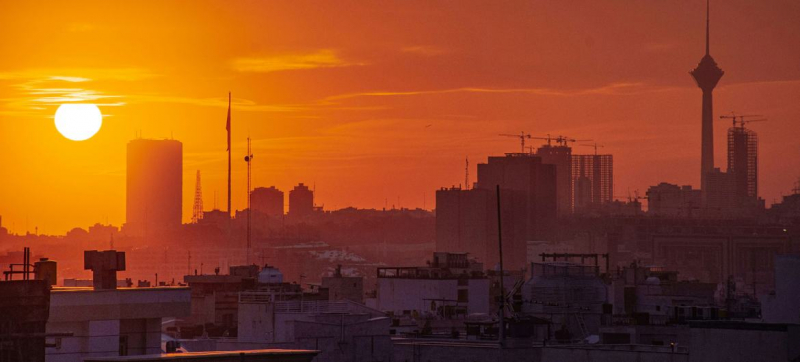

Tehran, capital of Iran. Iran crisis: IAEA calls for restraint as strikes continue Peace and security
On the third day of escalating violence in the Middle East, International Atomic Energy Agency (IAEA) chief Rafael Mariano Grossi called for a return to diplomacy, citing “increasing threats to nuclear security.” He spoke in Vienna before the IAEA Board of Governors.
Ядерная опасность
По словам Гросси, на данный момент нет признаков того, что какие-либо ядерные объекты Ирана, включая АЭС «Бушер» и Тегеранский исследовательский реактор, получили повреждения. Since the bombing began, radiation levels in countries bordering Iran have remained within normal limits.
However, Grossi said the nuclear threat is growing as Iran and many other countries in the region that have come under military attack have nuclear facilities. He noted that the UAE operates four nuclear reactors, and research nuclear reactors operate in Jordan and Syria. Other countries in the region also use nuclear technology in one form or another.
Grossi called for “maximum restraint in all military operations.”
Regional stability under attack
Meanwhile, at the UN Human Rights Council in Geneva, the Gulf states suffered from Iran’s retaliatory attacks with ballistic missiles and drones, condemned attacks on their sovereignty and called on Tehran to stop any “hostile escalation” that could threaten regional stability.
So far, missile strikes have been reported against Bahrain, Jordan, Oman, Kuwait, Qatar, Saudi Arabia and the United Arab Emirates, as well as Israel, whose armed forces responded to Hezbollah strikes from Lebanon on Monday.
According to incoming data, 550 civilians have been killed in Iran since Saturday. The Gandhi Hospital in Tehran was damaged on Sunday, the World Health Organization (WHO) said.
“Medical facilities are protected by international humanitarian law,” WHO Director-General Tedros Adhanom Ghebreyesus wrote on his page on the X platform.
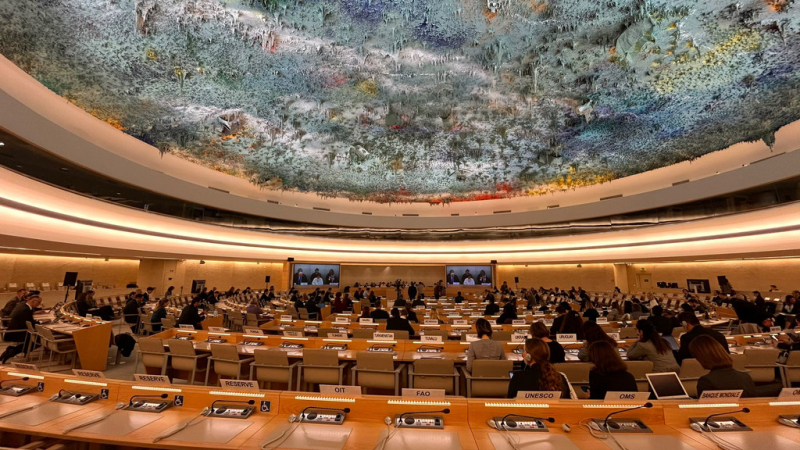
Meeting room of the UN Human Rights Council.
Speaking at the UN Human Rights Council, UAE representative Shahad Matar said that as a result of Iranian attacks since Saturday, February 28, three civilians have been killed in her country and another 58 people were injured.
“This outrageous and cowardly attack is a brutal… flagrant violation of our sovereignty, international law and the UN Charter,” Shahad said.
Kuwaiti representative Nasser Abdullah H. M. Alhaen condemned the Iranian missile strikes.
Attack on school in Minab
In response, Iran told the UN Human Rights Council that the country continues to be subjected to “indiscriminate and aggressive attacks” attacks. The day before, Tehran confirmed the death of its Supreme Leader Ayatollah Ali Khamenei.
“In recent days, schools have been bombed, hospitals have been indiscriminately attacked, civilian leaders have been killed, including the spiritual and religious supreme leader, and the headquarters of the Iranian Red Crescent Society and many other non-military buildings have been destroyed,” Iranian spokesman Ali Bahreini said.
He said that, according to the latest data, after Saturday’s attack on a girls’ school in the city of Minab in southern Iran, more than 160 students were killed and more than 100 were injured.
On Sunday, UNESCO representatives issued a statement emphasizing that educational institutions are protected under international humanitarian law, and that “attacks on educational institutions endanger students and teachers and undermine the right to education.” “The continued illegal military aggression against Iran demonstrates the dominance of brute force over the principles of rights human beings,” Bahraini told the Human Rights Council.
Earlier on Monday, Iran also sent a letter to the states participating in the UN Conference on Disarmament in Geneva and declared its right to self-defense “as long as aggression continues.”
Due to the “war of aggression,” all US military “bases, installations and assets” are now “legitimate targets,” Iran’s Permanent Mission to the UN in Geneva said.