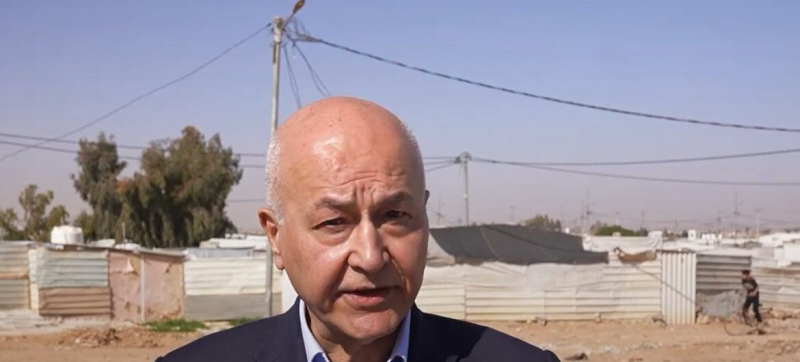

UN High Commissioner for Refugees Barham Salih in the Zaatari refugee camp in Jordan. Former refugee leads fight against global resettlement crisis Refugees and migrants
Barham Salih has spent much of his life crossing borders, first as a Kurdish exile fleeing repression in Iraq and now as UN High Commissioner for Refugees.
Having taken office on January 1 of this year, he did not linger in his offices. Within days, Salih left the meeting rooms at Geneva headquarters for dusty refugee camps in Kenya and Chad.
“The responsibility, in every sense of the word, is enormous,” he said in a recent interview, his voice briefly strained by the enormity of the task.
For Salih, now over 60, this work is not an abstraction. The new High Commissioner knows what forced displacement is, not from numbers, but from his own experience.
Born in Iraqi Kurdistan in 1960, he became a refugee himself as a teenager and spent years in exile – like an entire generation shaped by the repression and wars of Saddam Hussein’s era. He studied in the UK, made a political career and eventually returned to his homeland, becoming the eighth president of Iraq in 2018. This path largely determines his view of the fate of the 117 million people who today have no home.
“Behind every number there is a human life,” he says. “A person with his own aspirations, with the right to dignity and a better future.”
Salih wants to help everyone, but the global refugee support system is facing serious problems. The number of internally displaced people is growing and humanitarian funding is dwindling, forcing already limited resources to be distributed among more and more people.
A crisis that has no end
For a long time, the refugee protection system was built on the idea that their situation was temporary. People flee danger, receive protection and eventually return home when this becomes possible.
“Refugee should not become fate,” says Salih. “This is a temporary condition.”
However, as conflicts drag on and political decisions stall, this logic stops working. Today, almost two thirds of refugees live in so-called “prolonged migration” – five, 10, 20 years or more without any prospects. Some people spend their entire childhood in camps. Generations grow up without ever seeing the home from which their families fled.
“This is unacceptable. This is a violation of the basic human right to dignity,” says Salih.
His plans are ambitious: in 10 years, halve the number of people living in forced exile and dependent on humanitarian aid. However, he himself admits that such goals go far beyond the capabilities of his department.
“I am well aware that this significantly exceeds the current resources and capabilities of UNHCR,” he notes.
The key to the solution lies in what the humanitarian system has long failed to achieve: the transition from emergency assistance to economic integration. According to Salih, refugees should be able to work and contribute to the economies of the countries that host them, rather than being completely dependent on aid.
This will require a broad coalition: development banks, private investors, donor countries and states hosting refugees – many of which are themselves experiencing economic hardship. Political will will also be needed – while rich countries, on the contrary, are increasingly closing their borders.
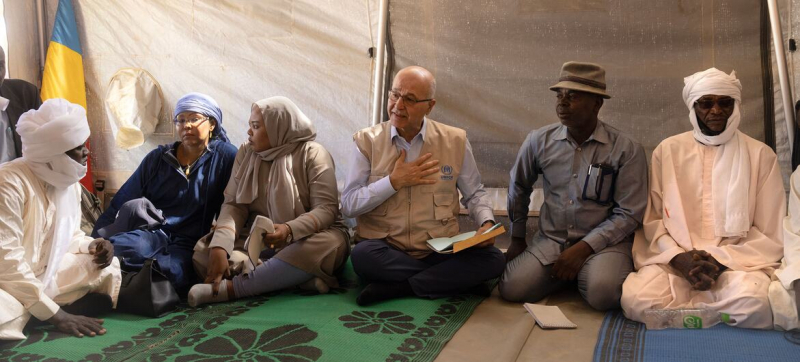
Barham Salih talks to Sudanese refugees in Chad.
At the limit of possibilities
One of the paradoxes of the refugee crisis is that the brunt of the burden falls on the countries least prepared for it.
“We have to support host countries, which are mostly low- and middle-income countries,” Salih says.
From Colombia to Uganda, from Chad to Bangladesh, these are the countries that host the majority of refugees, often without the necessary international support. Their schools, hospitals and labor markets are strained to accommodate new people while their own citizens face economic hardship.
“I am amazed by the generosity of these countries and communities,” says Salih.
But generosity has its limits. Without continued investment and real integration, the system risks becoming a permanent crisis – a global stratum of people who find themselves isolated, who are “warehoused” rather than accepted.
Message to refugees – and the world
In the Kakuma camp in northern Kenya – one of the largest in the world, where about 300 thousand people live – and in Turkish cities, where more than 10 years after the exodus they remain Syrians, Salih heard stories of people who managed to overcome despair.
“The stories of resilience that I hear from every refugee are not an abstraction, they are reality,” he says.
“I say to young people: we will ensure that you can be independent,” adds the High Commissioner.
This means moving away from viewing refugees solely as victims and recognizing them as people capable of building their own future. But it also places a responsibility on the international community to create the conditions in which this becomes possible.
The world is still very far from this. Conflicts continue to rage across the planet. Budgets for humanitarian organizations are being cut. Political consensus is eroding. And the number of refugees is growing – and behind each number, as Salih emphasizes, there is someone’s broken life.
The result of his first trips was the realization of not only the scale of the crisis, but also its protracted nature.
“Refugee should be a temporary condition, not a constant pain,” says Salih.
For millions of people in camps like Kakuma, the line between the first and the second has almost disappeared.