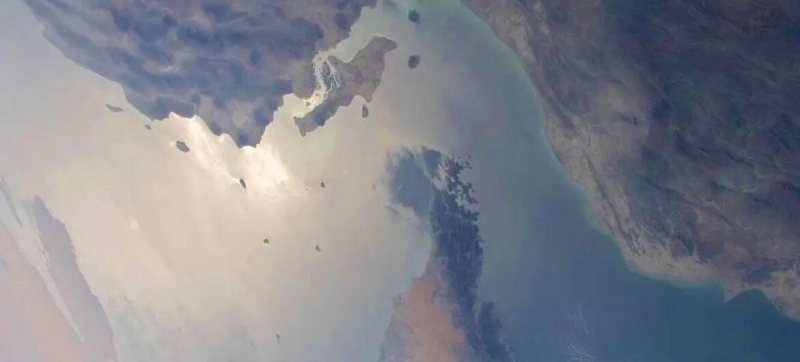

Satellite image of the Strait of Hormuz separating the United Arab Emirates and Iran. Middle East: more than 20 thousand sailors are “trapped” at the Strait of Hormuz Peace and security
More than 20 thousand sailors and about 3,200 ships are unable to leave the Persian Gulf area west of the Strait of Hormuz amid the war in the Middle East, the International Maritime Organization (IMO) reports. The UN agency is holding an emergency meeting in London to discuss measures to support seafarers and ships trapped on one of the world’s key trade routes.
According to the British maritime security service, 21 incidents were recorded between February 28 and March 17, including 16 attacks and five cases of “suspicious activity.” Among them are attacks on tankers and container ships off the coast of the UAE and Iraq, which led to fires and the evacuation of crews.
The lives of sailors are under threat
IMO Secretary General Arsenio Dominguez recalled that since the beginning of the conflict, at least seven sailors have been killed as a result of attacks on ships, and several more were injured.
“Whenever shipping is seen as collateral damage in conflicts, the entire world suffers—from the global economy to food security,” – said the head of the IMO.
He emphasized that about 20 thousand sailors remain in the Persian Gulf, “exposed to high risks and experiencing significant psychological stress.”
“I again urge all shipping companies to exercise extreme caution when operating in the affected region and, if possible, avoid it,” Dominguez said.
Disagreement over the holding of the meeting
The holding of the emergency session caused controversy among member states. The Iranian and Russian delegations questioned the need for the meeting, citing possible violations of IMO procedural rules, including a lack of proper notification.
Despite this, the IMO Council decided to use an article in the set of rules that allows a meeting to be held without complying with standard requirements.
Iranian strikes
Speaking on behalf of his country, the representative of the United Arab Emirates strongly condemned the Iranian strikes, calling them “unprovoked” and “illegal”, and stressed that they pose a serious threat to international shipping and regional stability.
He said the attacks were a “gross violation of the sovereignty and territorial integrity” of the country, including its territorial waters, and also violated basic principles of international law.
According to a representative of the delegation, there are dead and injured among sailors and port infrastructure workers. There are also additional risks to maritime safety and the environment.
The UAE stressed the need to protect freedom of navigation, especially in the Strait of Hormuz, and reaffirmed the right to self-defense in accordance with the UN Charter.
The situation of seafarers
A number of countries have focused on the situation of seafarers caught in the conflict zone.
Sweden welcomed the discussion, noting the need to keep the international community focused on the plight of the “innocent sailors” remaining stranded in the region.
The Netherlands stressed that seafarers continue to work in extremely dangerous conditions and are often unable to leave the area. The delegation called for ensuring their access to basic resources, including food and drinking water, and making their safety a priority. China called for an immediate cessation of hostilities, noting that only de-escalation can ensure security in the Strait of Hormuz.
The Chinese delegation also warned that if “normal shipping” is not restored urgently, it could have serious consequences for the global economy and trade. The United States, in turn, announced the creation of a reinsurance mechanism, which is expected to will help restore market confidence and restart energy and commercial transport.
The American delegation also welcomed additional initiatives, including a proposal presented to the IMO Council to create a safe maritime corridor for the evacuation of merchant ships from affected areas.
The US delegation called on partners to “support efforts to resume shipping through the strait.”