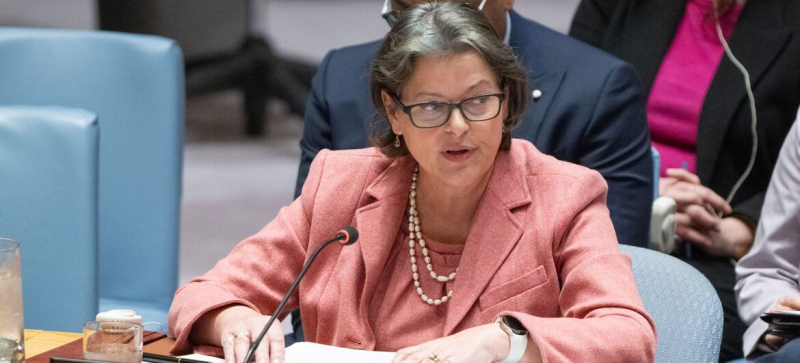

The acting head of the UN Mission in the Democratic Republic of Congo, Vivian van de Perre, briefs members of the Security Council. UN Security Council: escalation of hostilities in eastern DR Congo worsens humanitarian crisis Peace and security
The situation in the east of the Democratic Republic of the Congo (DRC) remains extremely tense amid continued activity by armed groups and a deteriorating humanitarian situation. The acting Special Representative of the Secretary-General in this country, Vivian van de Perre, warned about this when speaking at a meeting of the UN Security Council on Thursday.
She noted that despite the difficult conditions, the UN Stabilization Mission in the DRC (MONUSCO) continues to carry out its tasks in accordance with resolution 2808.
Escalation of hostilities and the risk of regional conflict
According to her, clashes between the armed group M23, supported by Rwandan forces, and government forces of the DRC, supported by allied forces, continue to intensify in the provinces of North and South Kivu. The front line is expanding, including areas near the border with Burundi, which increases the risk of regional escalation. In the province of Ituri, the situation also remains alarming.
According to van de Perre, there has been an increase in the use of attack drones and electronic warfare equipment, including jamming GPS signals.
In areas under M23 control, the formation of parallel administrative structures continues, which undermines public administration and complicates the delivery of humanitarian aid.
Diplomatic efforts continue
Despite the aggravation of the situation, diplomatic steps are being taken, the speaker noted. The UN welcomed the recent confirmation by the Democratic Republic of the Congo and Rwanda of their commitment to the implementation of the so-called Washington Agreements. In parallel, efforts continue through the Doha processes and under the auspices of the African Union to establish ceasefire monitoring mechanisms.
In mid-February, the acting Special Representative visited Goma, the first time a plane had landed at the local airport in more than a year since flights had been suspended. During the visit, consultations were held with key partners and stakeholders to advance practical agreements to launch the monitoring mechanism.
In this regard, van de Perre called on the Security Council to facilitate the early opening of Goma and Kavumu airports and the resumption of flights, emphasizing that air travel is extremely important for the population and humanitarian organizations in the east of the Democratic Republic of the Congo.
Protection of civilians
The UN mission continues to implement measures to support the civilian population. In particular, the peacekeepers ensured the protection of almost 3 thousand people sheltered at its base in Fataki, and also increased patrolling. Thanks to the mission’s operations, about 18 thousand farmers were able to harvest and transport crops.
The UN emphasizes the importance of security sector reform and strengthening state institutions as key conditions for ensuring sustainable peace.
Large-scale human rights violations
Since December 2025, numerous serious human rights violations have been documented, including murder, kidnapping and conflict-related sexual violence. 173 cases of sexual violence have been confirmed, affecting 111 people, mostly women and girls. The UN notes that the real scale of violence is likely much wider.
Human rights defenders, journalists and civil society representatives in areas controlled by armed groups continue to face intimidation and arbitrary detention.
The humanitarian crisis is deepening
The humanitarian situation has changed significantly, said the acting head of the UN Mission. There are approximately 6.4 million internally displaced people in DR Congo, almost 4 million of them in the eastern regions. At the same time, approximately 4.3 million people have already returned to their homes.
The UN warns that 26.6 million people in the DRC, or about a quarter of the country’s population, could suffer from food shortages in 2026.
Humanitarian operations face serious challenges, including funding cuts and security threats. Since December, at least 10 incidents have been recorded that have put humanitarian workers at risk.
The recent death of a UNICEF worker when her home in Goma was hit was a tragic reminder of the risks faced by aid workers, Van de Perre said.
Call to action
At the end of the briefing, she stressed that to achieve peace in the east of the DRC, it is necessary coordinated international efforts.
“The people of Congo, who have long suffered from violence and illegal exploitation of resources, deserve to see peace and good governance become a reality,” the speaker said. She called on the parties to respect their obligations and on the Security Council to take decisive action to bring those responsible to justice and prevent further violence.