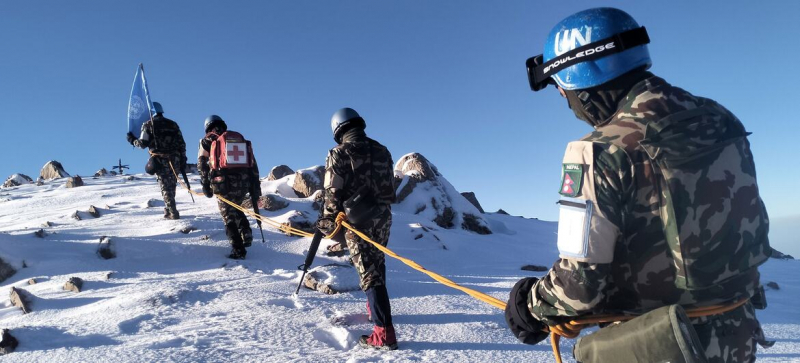

The UN Disengagement Observer Force (UNDOF) continues to carry out its tasks. Peacekeeping: UN warns of growing threats to blue helmets in the Middle East Peace and security
UN peacekeeping operations in the Middle East face growing security threats, financial constraints and political uncertainty. This was stated on Friday by UN Deputy Secretary-General for Peacekeeping Operations Jean-Pierre Lacroix.
Speaking to reporters via video link from Jeddah after a lengthy visit to the region, Lacroix reported an increase in the number of dangerous incidents involving peacekeepers and highlighted the fragile environment in which the missions operate. According to him, despite the increasingly complex situation on the ground, UN peacekeepers continue to fulfill their assigned responsibilities. Speaking about the UN Interim Force in Lebanon (UNIFIL), Lacroix stressed that the mission will continue to operate at least until the end of December 2026. According to him, UNIFIL remains focused on supporting Lebanese Armed Forces and promoting the implementation of Security Council Resolution 1701, which ended fighting between Israeli forces and Hezbollah in 2006. He also welcomed recent government announcements of progress in establishing operational control in the south of the country, while acknowledging that “there is still a lot to be done.” do.”
Growing danger
At the same time, Lacroix expressed serious concern about the increasing number of incidents involving UN peacekeepers, especially those involving the Israel Defense Forces. “The frequency of these incidents was quite high – and it continues to increase,” he said, warning that several clashes “could lead to extremely tragic consequences” for peacekeepers. He said he had raised the issue with Israeli officials, emphasizing that “no one is interested in putting the lives of peacekeepers at risk,” and reminding all parties of their responsibility to ensure the safety of UN personnel. Lacroix also described widespread destruction in southern Lebanon, where entire villages devastated, and civilians still cannot return to their homes. According to him, this undermines the prospects for recovery and reconstruction of the region.
Financial problems and adaptation
In addition to security threats, Lacroix drew attention to the impact of funding shortfalls on peacekeeping operations. He noted that UNIFIL and other missions have been forced to implement cost-saving plans due to delays in the payment of contributions by some UN member states. But he praised the peacekeepers’ ability to adapt to challenging conditions, saying they have been able to “mitigate the impact” of financial constraints through innovative solutions and adjustments operational activities.
Syria and regional dynamics
Speaking about the situation in Syria, Lacroix said that the UN Disengagement Observer Force (UNDOF) continues to fulfill its mandate with the active support of both the Security Council and the Syrian authorities. He noted, however, that the situation on the ground has changed significantly since Israeli troops took up positions in the zone of separation defined by the 1974 agreement. “We would like to return to the situation when UNDOF was the only military contingent in the zone of separation,” Lacroix said, citing recent negotiations between Israel and Syria, brokered by the United States, was “positive.” He also stressed the importance of UN mine action in Lebanon, Syria, the Gaza Strip and the Occupied Palestinian Territories as a whole, saying the needs are “huge” and calling for increased donor support.