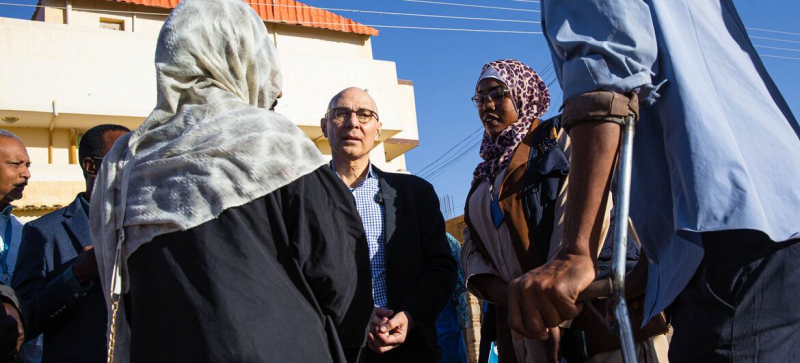

UN High Commissioner for Human Rights Volker Türk meets with local authorities and NGOs in Dongola, Sudan. UN High Commissioner: the spirit of the Sudanese people is not broken, despite the horrors of war Human rights
Despite the unprecedented scale of violence, the Sudanese maintain the spirit of struggle for peace, justice and freedom. This was stated by UN High Commissioner for Human Rights Volker Türk, speaking in Nairobi, Kenya, following his official trip to Sudan. He warned of the risk of mass atrocities in Kordofan and called for the immediate protection of civilians.
Turk spent five days in Sudan, visiting Port Sudan, Dongola and the Ad-Dabba and Merowe areas of the Northern State. He met with government officials, civil society and humanitarian organizations, journalists, lawyers and people who have fled violence in El Fasher in North Darfur.
Youth on the front line
Turk spoke about young Sudanese who help their communities.
One of the civil society leaders told him: “We cannot stop the war, but we will do everything possible to save the lives of civilians.”
Another volunteer noted: “Young people are paying the price of war. Sudanese youth are on the front lines of this war.”
The High Commissioner also met with women who lead organizations providing legal and humanitarian assistance to Sudanese women affected by violence and human rights violations during the war.
Kidnappings and sexual violence
During the visit, the High Commissioner met with Hawa (not her real name), who was studying for a master’s degree in psychology when she forced to flee El Fasher after the death of her 19-year-old son. On the way, she said, she was robbed and beaten, and her husband was kidnapped and tortured by Rapid Reaction Force fighters, demanding a ransom.
According to the High Commissioner, the parties to the conflict and those who supply them with weapons, finance and benefit from the war must hear the testimony of 20-year-old Aisha (not her real name): “On October 20, we fled El Fasher on a donkey cart – it was the only transport we could afford. On the way to the village of Garni we saw many bodies. We met armed men on camels who ordered: “Give us the women.” My brother tried to stop them. He was shot in the legs. My mother cried and said: “Leave my children, take me instead.” They hit her, they took me away and told me to remain silent, otherwise they would kill my mother. And then… what happened happened. I haven’t had a period since then.”
The Office of the UN High Commissioner for Human Rights has documented numerous cases of sexual violence in El Fasher, along its escape routes, and in the nearby Zamzam camp.
Alarming situation in Kordofan
The High Commissioner expressed serious concern about the situation in Kordofan, comparing it to a crisis in El Fasher before its capture. He noted that the South Kordofan capital Kadugli is already facing a siege, massive displacement of people and the risk of full-scale famine.
Volker Türk called on all parties to the conflict to ensure the protection of civilians and civilian infrastructure, to guarantee the safe exit of the population from combat zones and unimpeded access for humanitarian aid.
“Let human rights become the basis for trust, ending war and building sustainable peace. This is difficult – but not impossible, given the strength and resilience of the Sudanese people,” said the High Commissioner.