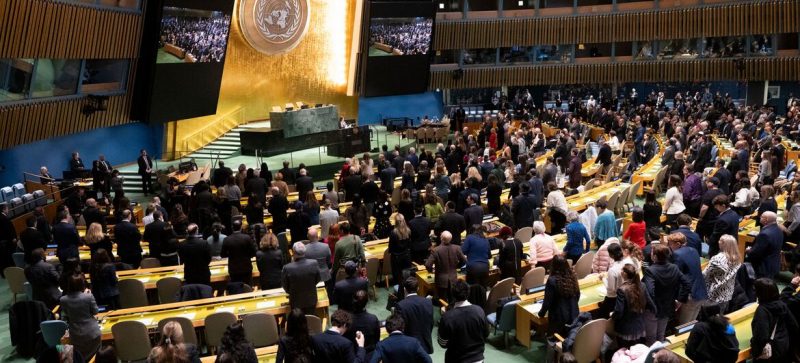

A minute of silence at the UN General Assembly in memory of the victims of the Holocaust. International Holocaust Remembrance Day at the UN: “Hate begins with words” Human rights
“They don’t have graves. But they live in our memory.” With these words, 97-year-old Evelyn Conrad, who fled with her mother from Nazi-occupied Vienna in 1939 and moved with her parents to the United States, began her speech at UN headquarters. On Thursday in New York she took part in an event to mark International Holocaust Remembrance Day.
Evelyn’s father, who was in Paris in 1939, was able to obtain visas for his wife and daughter. But most of the family did not survive the Holocaust. Evelyn remembers with particular warmth her grandmother Eleanor, who remained in Vienna and, as her family learned years later, died on the way to the death camp in Treblinka.
“I hoped to the last that she was alive. But in the end, I had to come to terms with the truth,” Evelyn said.
Uphold the dignity of every person
International Holocaust Remembrance Day, established by the United Nations, is celebrated on January 27 – the day when Soviet troops liberated prisoners of the Nazi camp Auschwitz in 1945. In September of the same year, World War II ended, and in November, the Nuremberg Trials, an international trial of the former leaders of Nazi Germany, began.
“This trial marked the beginning of a new era in international criminal law. An era in which individuals, including the most powerful, are held accountable for their actions,” said UN Secretary-General António Guterres.
He noted that the fight against anti-Semitism, racism and hatred continues, and emphasized the need to protect the dignity of every person and honor the memory of those killed.
“We have gathered here to honor the memory of the victims of the Holocaust with deep sorrow. These were mothers and fathers. Sons and daughters. Grandparents, grandchildren and granddaughters. Six million Jews killed simply because they were Jews,” said the UN chief.
He also recalled the persecution of people with disabilities, Roma and many others.
Memory not as fear, but as knowledge
The Roma people were represented at the UN event by Galina Tomenko. Her age and health did not allow her to fly to New York from Ukraine. She recorded a video message for the meeting participants, in which she spoke about the extermination of Roma during the Nazi occupation.
In the early 1940s, Galina’s family moved from the village of Tsarichanka to the Dnieper to escape violence.
“Survival depended on constant movement, silence and fear. My family has experienced famine, genocide, uncertainty and loss. Many Roma families were completely destroyed,” said Galina.
“Today I speak not only to remember the past, but also to pass on responsibility. My generation survived and preserved the memory. Now we pass on this memory to our children and grandchildren – not as fear, but as knowledge, dignity and protection,” she added.
Do not remain silent when witnessing hatred and dehumanization, but speak out “even louder than before,” called on the President of the UN General Assembly, Annalena Burbock. The Holocaust, she recalled, did not begin with gas chambers. It began with words, laws, arson. From the silence of neighbors who saw how Jewish stores were boycotted.
“Challenging someone’s rights just because of who they are, where they come from, or what color their skin is always leads to the same result: dehumanization, which ends up affecting everyone,” Burbock said.
A simple idea that is difficult to bring to life
Every person must do everything possible to prevent such hatred, destruction and terror from happening again, said Marion Blumenthal Lazan. Together with her brother and parents, she spent several years in camps – in the Netherlands and Germany.
In 1996, she published a memoir, “Four Perfect Pebbles,” about survival and hope in the most monstrous circumstances. In the book, Marion says that in the Bergen-Belsen camp in Germany, their only food was a piece of bread and watery soup once a day. After some time, even this ration was given out only once a week. The prisoners were sent to shower only once a month, and each time they were afraid that gas would come out of the taps instead of water.
“I spent most of my time playing games in an imaginary world. One game became especially important for me: I decided that if I found four pebbles of approximately the same size and shape, then all four members of my family would survive. I played the game over and over and always tried to find my four stones,” she said.
Father Marion did not survive. But she, her mother and brother managed to hold out and eventually left for the USA.
“Let us treat each other with kindness, compassion and respect. This is such a seemingly simple idea, but it is so difficult to put into practice,” Marion said from the rostrum of the UN General Assembly.
“How we treat each other, how we behave and how we interact is entirely up to us,” she added.