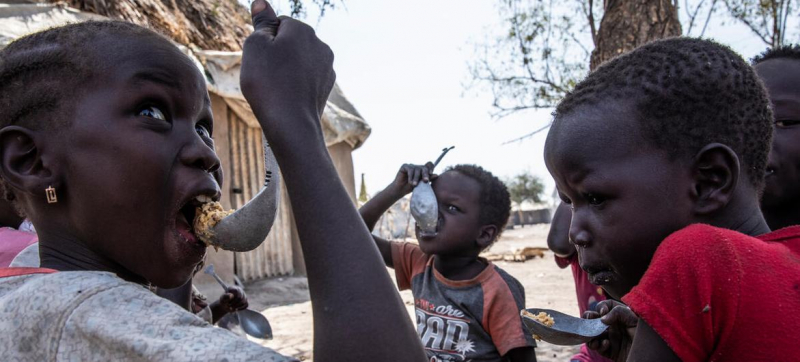

Children in Jonglei State, South Sudan, where the World Food Program is providing food rations to families in need (archive). South Sudan: “All the conditions for a humanitarian catastrophe are present” Peace and security
Military tensions between government forces and opposition groups in South Sudan are “rapidly increasing.” Speaking at a briefing for journalists at UN headquarters in New York on Friday, the acting head of the UN Mission in South Sudan (UNMISS), Anita Kiki Gbeho, said, that Jonglei state has become a “spot of tension” where civilians are caught in the crossfire.
The conflict has forced more than 200,000 people to flee their homes this month, according to the UN spokeswoman, who also serves as the country’s Resident Coordinator.
She also warned about the spread of cholera. Over 500 cases of the disease were reported throughout the country this month alone. At the same time, treatment centers are overcrowded and lack medicines and other necessary supplies.
Difficulties in delivering aid
Although humanitarian operations continue, access is difficult due to restrictions on movement on roads and rivers This interferes with the delivery of assistance and medical evacuation.
The world’s youngest state gained independence in 2011, but soon plunged into civil war. The clashes have erupted between forces loyal to President Salva Kiir’s national army and supporters of main opposition leader Riek Machar, who is currently on trial on serious charges, including murder, which he denies.
Following opposition gains, government forces launched an offensive this week in three districts of Jonglei state. All civilians and aid workers were urged to evacuate.
Humanitarian sites looted
According to Gbeho, “humanitarian sites are looted and destroyed (including at least seven in Jonglei), and aid workers are being intimidated.” UN peacekeepers face similar challenges.
Civilians are suffering as a result of the disruption of aid supplies and peacebuilding efforts. UNMISS warns that “all the conditions for a humanitarian catastrophe are present.”
Speaking via video link from South Sudan, Gbeho stressed that despite the release of $10 million from the Central Emergency Response Fund, “more assistance is needed.”
Restore peace
Despite the acute shortage of resources, the priority remains “cessation of hostilities, protection of civilians and preservation of the peace process”, as well as cooperation with African Union and Intergovernmental Development Organization to “renew commitment to the 2018 peace agreement.”
Recalling the words of the UN Secretary-General, Gbeho emphasized that “the solution to the current crisis must be political, not military.” She called on South Sudan’s leaders to take “urgent action to end the fighting, reduce tensions through inclusive dialogue and return to consensus-based decision-making.”
“The defining moment”
In conclusion, Gbeho emphasized that only the South Sudanese themselves can change the situation for the better.
She called the current stage “a defining moment – a critical crossroads for South Sudan.” According to the head of the UN Mission, decisions taken now could lead the country either to peace or to further expansion of the conflict.