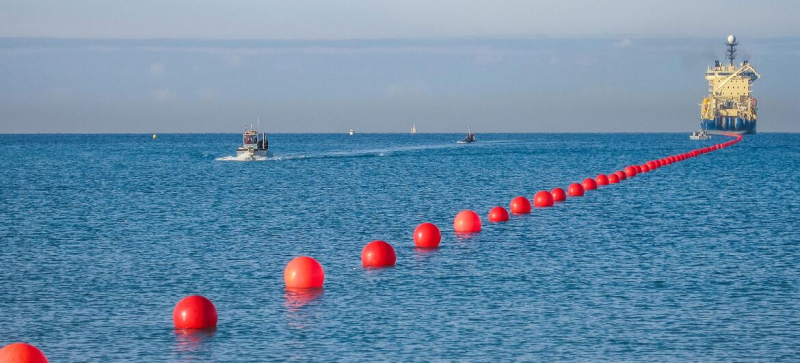

Red buoys mark the route of the submarine cable. Invisible Highways: The Global Network of Undersea Cables Providing Internet Connectivity Around the World Economic development
About 99 percent of international Internet traffic travels through submarine cables. You have the opportunity to read this article thanks to them.
Every day we send countless emails, take part in video calls, use search engines and streaming services, and do online banking – and all of this seems to be taken for granted.
Continuous access to information
Exchanging data in a split second has become a common part of life in many countries of the world. And yet we rarely think about what makes this possible – the complex global network of cables laid in the depths of the ocean, invisibly connecting us to each other. In the information age, undersea cables have become the foundation of digital communications, the Deputy Secretary-General of the International Telecommunication Union told the UN News Service in an interview (ITU) Tomas Lamanauskas ahead of a global summit on the topic, which opened Monday in Portugal. The infrastructure handles trillions of dollars of transactions and ensures uninterrupted access to information. About 99 percent of international Internet traffic travels over submarine cables. Even the conversation that we are having right now is transmitted through these cables,” Lamanauskas noted during a video call with the News Service. “People are familiar with visible access points – mobile networks, satellites, fixed Internet. But the underlying infrastructure that supports them is a huge network of undersea cables, our digital backbones,” he added. These “invisible backbones,” which are fiber optic lines, are laid by cable-laying vessels hundreds of meters underwater. Lamanauskas stressed that as our dependence on digital communications grows, strengthening this infrastructure and developing collective strategies is becoming increasingly important. This is what the Second International Summit on the Sustainability of Submarine Cables, taking place in Porto on Monday and Tuesday, will focus on. We began to connect different parts of the world with the help of communication cables a long time ago. In 1850, Great Britain and France became the first countries connected by an undersea telegraph cable. Since then, technology has constantly evolved: telegraph services gave way to telephone networks, and then the advent of high-speed Internet provided by fiber optic cables. Today, these lines, laid along the bottom of the seas and oceans, transmit hundreds of terabits of data every second. There are more than 500 commercial submarine cables around the world, connecting continents. Relatively thin—about the thickness of a garden hose—these cables stretch for approximately 1.7 million kilometers. This is enough to encircle the Earth several times. Before laying cables, the bottom is carefully examined in order to select routes with the lowest risks and minimal impact on the environment. Then special vessels unwind huge spools of fiber-optic cable and lay it on the seabed. As these cables become the backbone of the global economy, any interruption in data transmission has an immediate impact, affecting economic activities, emergency and technological services, security systems and Internet access for billions of people around the world. There are between 150 and 200 incidents involving submarine cables every year – an average of three to four per year. week. According to the ITU representative, there have been many large incidents in recent years. “For example, in 2024, incidents with submarine cables in the Red Sea led to disruptions affecting 25 percent of traffic between Europe and Asia,” Lamanauskas said. Cable disruptions can be caused by earthquakes, underwater landslides and volcanic eruptions. However, statistics show that about 80% of incidents occur due to human fault: cables are damaged by ships, in particular by anchors. Tomas Lamanauskas also cited the example of the island nation of Tonga, where since 2019 there have been three serious failures caused by earthquakes, volcanic eruptions and improper anchoring of ships. Due to the lack of an extensive network in remote regions, a cable cut can leave a huge area without communication. “Imagine if you and your entire community were left without the Internet for a week and could not access critical services such as digital health and education,” said the deputy head of the ITU. “Imagine the impact on stock traders.” in New York there is even a one-millisecond delay due to cable overload or a submarine cable incident. Every moment matters,” he added. The ITU Deputy Secretary-General explained that in the event of an incident, engineers can usually quickly identify the affected area, and “the repair work itself is not always the hardest part.” The process of obtaining all necessary permits and licenses, especially when multiple jurisdictions are involved, can be significantly more complex. Depending on the location and scale, damage, the involvement of cable-laying vessels and repairs can take from several days to several weeks and even months. In areas with heavy shipping traffic, such vessels are usually located nearby, but reaching remote areas is much more difficult. In many countries, the situation is complicated by the lack of a focal point to manage such operational processes. Thomas Lamanauskas noted that laying new cables is a multi-year project: “This is large-scale planning, and, as a rule, it is expensive. While short cables cost millions, long cables can cost hundreds of millions.” The International Telecommunication Union, the UN digital agency, is working to improve reliability, including through standards development and technical advice. The organization’s priorities include measures to improve infrastructure strength, simplify maintenance and repair procedures, and introduce more environmentally friendly practices. ITU does not directly repair cables. “Over the past 40 years, the throughput of these optical cables has increased by an average of 40 percent per year. This is exponential growth, which in turn drives exponential growth for the Internet,” added Tomas Lamanauskas. With unprecedented growth in communications demand, ITU’s efforts will play a key role in shaping the future of the global digital space.
Instant data transfer
Cable malfunctions
Every millisecond matters
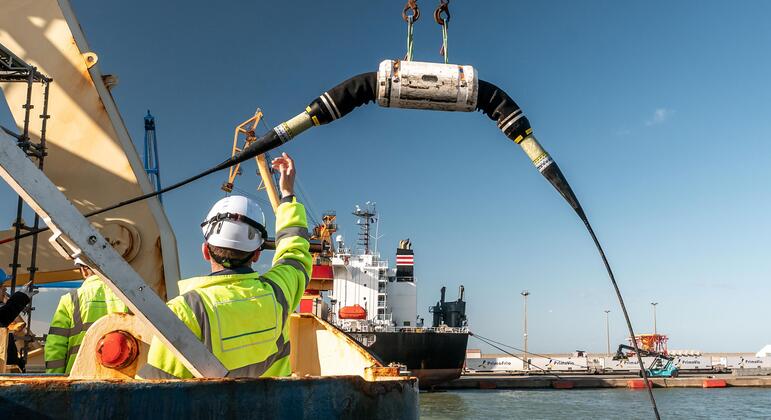
Cable repair
What does ITU do?