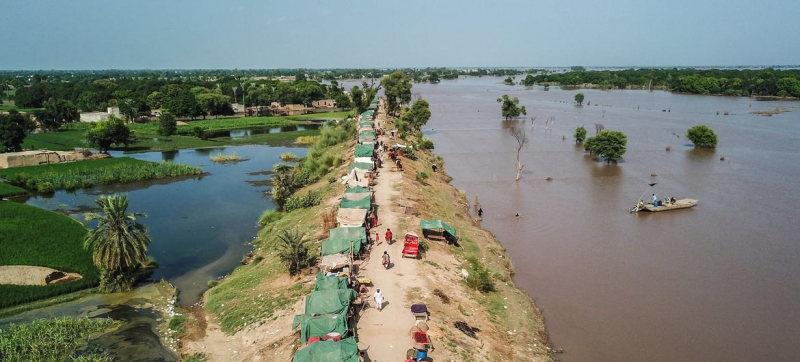

Consequences of floods in Pakistan. Photo from the archive Head of the UN Convention: climate cooperation is a source of stability in an unstable world Climate and environment
Against a backdrop of geopolitical tensions and weakening trust in multilateralism, international climate cooperation can deliver security and economic prosperity. This was stated by the Executive Secretary of the United Nations Framework Convention on Climate Change (UNFCCC) Simon Steele.
He spoke in Istanbul at a press conference as part of discussions on the planning of the 31st session of the Conference of the Parties to the UNFCCC (COP 31), which will be held in Antalya. Steele thanked Turkey, the COP31 chair-designate, and Australia, as track chair, for the “valuable discussions.”
New “world disorder”
The upcoming climate conference will take place during “extraordinary times,” according to the head of the climate secretariat.
“We find ourselves in a new world disorder,” Steele said. “This is a period of instability and insecurity. The era of forceful pressure and trade wars. The very concept of international cooperation is under attack.”
Nevertheless, it is climate action, he emphasized, that can become a factor in sustainability. “In the face of the current chaos, we can and must ensure a new era of international climate cooperation,” Steele said.
From problem identification to the implementation stage
The Executive Secretary recalled that global efforts to combat climate change have gone through several stages over the decades, from recognition of the problem itself to the development of agreements, including the Paris Agreement.
“It didn’t solve the climate crisis, but it changed our course,” he said, adding that the agreement proved countries’ ability to achieve breakthroughs when they act together.
He also cited specific figures: in the ten years since the adoption of the Paris Agreement, investments in clean energy have grown tenfold – from 200 billion to more than two trillion dollars annually, and in 2025, investments in it are more than twice as high as investments in fossil fuels fuel.
Now, he said, the world must actively promote the third stage – the stage of practical implementation.
“This is a stage of acceleration and scaling,” Steele emphasized
What should be done
This is about implementing the agreements reached at the end of the first Global Stocktaking: doubling energy efficiency, tripling clean energy capacity by 2030, a just transition from fossil fuels, strengthening resilience and increasing financing for the most vulnerable countries and populations.
“By the second Global Stocktake in 2028, we should be on track to meet these commitments,” said the head of the UNFCCC.
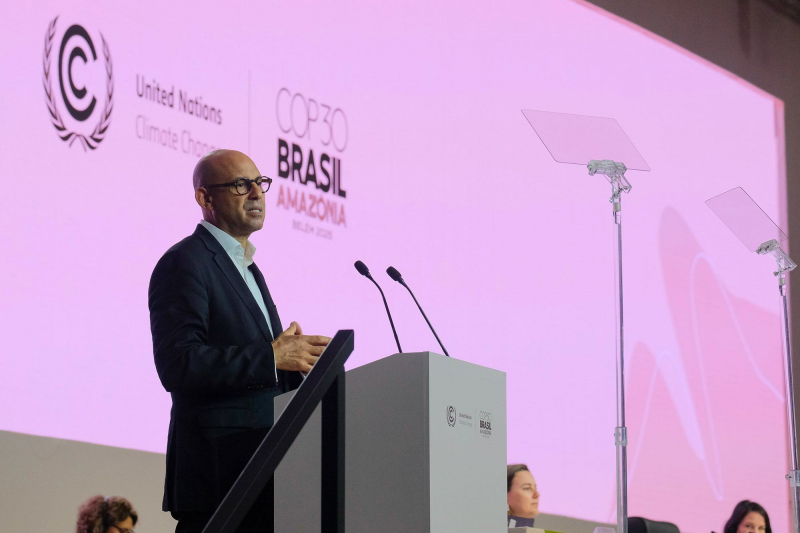
Executive Secretary of the UN Framework Convention on Climate Change Simon Steel speaks at COP 30 in Brazil.
Progress can be achieved by rapidly scaling up climate projects and partnerships between governments, financial institutions and businesses, while dramatically increasing available financing, especially for developing and vulnerable countries.
The executive secretary warned that failure to lead on climate would mean losing economic opportunity.
“Those who retreat from climate leadership are simply giving away this gold mine of new jobs and the dividends from their creation to competing economies,” he noted.
Climate and safety
“Taking action to combat climate change contributes to overcoming the daily challenges faced by citizens around the world,” he said.
The UN representative emphasized that climate cooperation is not an abstract goal, but a practical response to instability, since the consequences of climate change harm every person and the entire economy. We are talking about rising hunger, forced displacement, conflicts over resources and distrust of governments that cannot provide citizens with the basic necessities.
Steele called access to electricity especially important for developing countries, where hundreds of millions of people still live without it. In addition, climate action is necessary to feed the world’s population.
“Climate cooperation is the antidote to today’s chaos and coercion,” he said. “Renewable energy is the clearest and cheapest path to energy security and sovereignty,” Steele added. In conclusion, Steele emphasized that Turkey, as a crossroads of regions and diplomatic traditions, can become a platform for promoting common solutions. The UN, he added, will support the chairs “every step of the way” to ensure the conference is a success for people, prosperity and the planet.