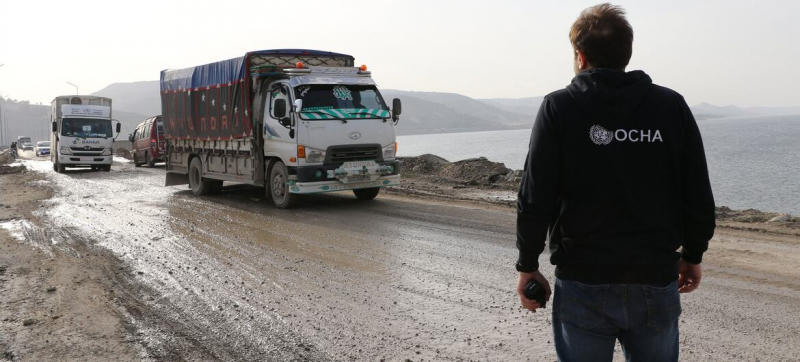

Trucks with humanitarian aid in northern Syria. Syria: UN calls to consolidate truce and increase aid amid ongoing instability Peace and security
Following the ceasefire agreement in northeast Syria, a window of opportunity opens to advance a political transition, but the security situation remains fragile and humanitarian needs are enormous. UN representatives announced this at a Security Council meeting on Friday.
Deputy Special Envoy of the Secretary-General for Syria Claudio Cordone, speaking for the first time at the UN Security Council in his new capacity, welcomed the agreement announced on January 30 between the government and the Syrian Democratic Forces.
Steps towards integration in the northeast
“We look forward to its full and rapid implementation in the plan for the peaceful integration of northeast Syria, the protection of the rights of Syrian Kurds and the safe, dignified and voluntary return of displaced persons, as well as the creation of conditions under which all residents of this part of the country can live with dignity and without fear,” he said.
According to Cordone, hostilities have generally stopped, and work on mechanisms for implementing agreements is progressing positively. At the same time, the UN calls for investigations into reports of violations and abuses and for bringing those responsible to justice.
The UN representative noted that the situation around detention centers in northeast Syria is being closely monitored, including the transfer of suspects with links to Daesh (ISIS) to Iraq.
Tensions in the south and external factors
In the province of Es-Suwayda, clashes again occurred between security forces and local armed groups, Cordone noted. Israeli operations also continue.
“We once again call for full respect for international law, the sovereignty and territorial integrity of Syria,” the UN spokesman said.
Human rights and the role of women
Cordone emphasized that protecting human rights, addressing the issue of missing persons and promoting transitional justice are cornerstones trust. He especially noted the contribution of Syrian women and civil society.
The UN mission, according to him, intends to expand interaction with the authorities and other partners.
Hundreds of thousands of victims, millions in need
To the members of the Council on behalf of the Emergency Relief Coordinator The representative of the Office for the Coordination of Humanitarian Affairs, Lisa Douten, spoke at the UN.
According to her, recent fighting has forced tens of thousands of people to flee their homes. Although many have returned, about 130,000 remain displaced. More than 90 percent of them are women and girls.
Despite the challenges, the UN and partners are expanding operations. Trucks with food, water, medicine and fuel were sent to the affected areas. In a number of places, power supply was partially restored.
Recent estimates indicate that the food situation has improved somewhat, but some 700,000 people still face extreme food insecurity and millions face moderate food insecurity.
Douten added that this week heavy rains caused flooding in the areas of Idlib and northern Latakia: two children were killed, thousands of internally displaced people were injured, and tents were destroyed.
Three key areas
To overcome the crisis, the UN representative emphasized, efforts are needed to prevent a new escalation, investing in rebuilding infrastructure and livelihoods and maintaining vital humanitarian funding.
“We have a rare opportunity to help the Syrian people turn the tide of one of the world’s worst humanitarian crises. Let’s continue to do everything possible so that they can take advantage of this chance,” she concluded.