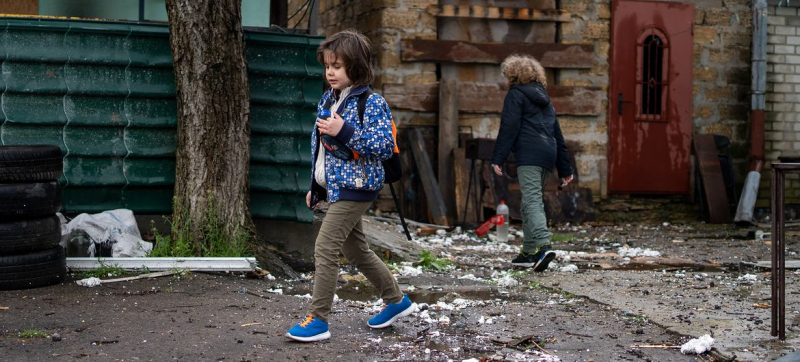

Children walk past a destroyed house in Kherson, Ukraine. (archive) Ukraine: young residents of Kherson spend their childhood in bomb shelters Peace and security
Today, only 5 thousand children remain in Kherson out of more than 60 thousand who lived in the city before the war. The United Nations Children’s Fund (UNICEF) is helping to keep them safe by supporting efforts to build bomb shelters. There, deep underground, young Kherson residents spend their childhood. The head of the Ukrainian representative office of UNICEF, who joined via video link from one of these bomb shelters, told reporters in Geneva about this.
According to Munir Mammadzade, Kherson is subjected to daily artillery shelling, which leads to the destruction of houses and critical infrastructure. He spoke about the fate of one family that had recently suffered a blow: “On that frosty night at the end of January, Catherine pushed her two children into the corridor and ran out after them herself. The explosions were louder than usual even by the standards of Kherson, and suddenly a powerful blow destroyed their house.”
Life under attack
Sixteen-year-old Daria and eight-year-old Artem were injured by shrapnel. Catherine required surgery, but fortunately they all survived. A local UNICEF-supported mobile child protection team visited the family in hospital that same day, providing psychosocial support, cash support and emergency supplies. “Today the family is recovering from their injuries, but the house they rent outside the city does not guarantee their safety in this brutal war,” Mammadzadeh said.
Fight for survival
However, he added, the tragedy is that four years after the start of a full-scale war, there are almost no safe places left in Kherson. “In the city of Kherson and the region where I am today, the daily life of children and their families is a struggle for survival,” said the UNICEF representative. “This front-line area is covered with anti-drone nets, and the childhood of Kherson residents passes literally underground.”
Protection centers
In Kherson today there remain 5 thousand of the 60 thousand children who once lived peacefully with their families and friends while they childhood remains unchanged on February 24, 2022. Today they study, play and sleep in basements to escape shelling, the UNICEF representative noted.
“At the UNICEF-supported child protection center, I interacted with families and staff, including psychologists and social workers. “They all speak of the extreme exhaustion of families forced to live in a state of constant anxiety 24 hours a day,” he said. “The constant fear of attack, the endless need to hide in basements and isolation at home with limited social contacts take a heavy toll on children and adolescents, affecting their mental and physical health.”
At the same time, Mammadzadeh continued, such spaces provide an opportunity to “take a break from the horrors happening above.” “There is an incredible determination here to continue living. UNICEF helps children and families with exactly this,” he emphasized.
Together with local authorities and partners, the UN Children’s Fund supports seven child protection centers across the Kherson region, provides outreach teams to provide vital emergency assistance to victims, and strengthens alternative care systems for the most vulnerable children.
In addition, UNICEF has created spaces for early development and digital learning in Kherson, as well as youth centers for developing skills and social connections. People receive cash assistance and local utilities support efforts to restore heating and water supplies. Similar assistance is provided in other front-line areas.
Forced to flee
Mammadzade also drew attention to the plight of children forced to leave their homes. We are talking about 2.6 million young Ukrainians. About 1.8 million of them live as refugees outside the country, and more than 791 thousand are displaced within Ukraine.
The war, according to the UNICEF representative, is particularly acute in the front-line areas, but people are suffering throughout the country: attacks on civilian areas continue and lead to the destruction of homes, schools, hospitals and infrastructure. “So, the number of deaths and injuries of children in Kyiv and the Kyiv region last year was almost four times higher than in 2024,” Mammadzadeh recalled. – A recent UNICEF study found that one in three adolescents aged 15–19 years had been forced to move at least twice, with the search for safety remaining the main reason for fleeing. Other important factors include the quality of education and the opportunity to develop skills.”
“Children and youth have not given up on their future – and we will not allow this either,” the representative of the UN Children’s Fund summed up his speech. “UNICEF is working across Ukraine and neighboring countries hosting refugees to support children affected by displacement and ongoing violence.”
The International Organization for Migration helps Ukrainians
Arthur Erken, regional director of the International Organization, also spoke to journalists in Geneva about providing assistance to Ukrainians on Migration (IOM) in Europe. Speaking from Vienna, he said that since the full-scale invasion, more than 4.4 million people who fled their homes had returned to the areas of origin.
Of the million people who returned to the territory of Ukraine from abroad, 372 thousand could not move to their native lands and remain in the status of internal migrants. IOM is providing them with full support to prevent further waves of displacement.