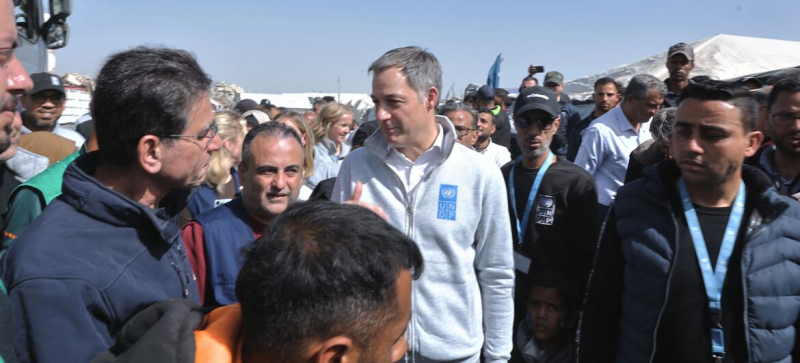

UNDP head Alexander De Croo visited the Gaza Strip. Head of the UN Development Program: without expanded access, clearing the rubble in Gaza will take seven years Humanitarian assistance
The United Nations has the resources to expand relief and reconstruction operations in Gaza, but lacks the necessary access to carry out these vital tasks. Administrator of the United Nations Development Program (UNDP), Alexander De Croo, told reporters on Tuesday.
De Croo, who chose Gaza for his first foreign trip since taking office in November 2025, called for greater access to the occupied Palestinian territory for UN agencies. This is necessary to intensify work on clearing debris and removing waste, providing the population with housing and medical services, as well as evacuating patients.
On Monday, De Croo visited the Firas market in the center of Gaza City, where about 370 thousand tons of waste have accumulated during two years of war. Due to the collapse of the waste disposal and sewerage systems, this area has turned into a huge, fetid dump.
“It will take seven years to clear all the rubble”
UNDP bulldozers began clearing the waste a week ago, a glimmer of hope for Gazans. The goal is to reopen market as the center of economic activity. The agency also supports efforts to provide temporary housing, provide basic services, and restore education and health care systems.
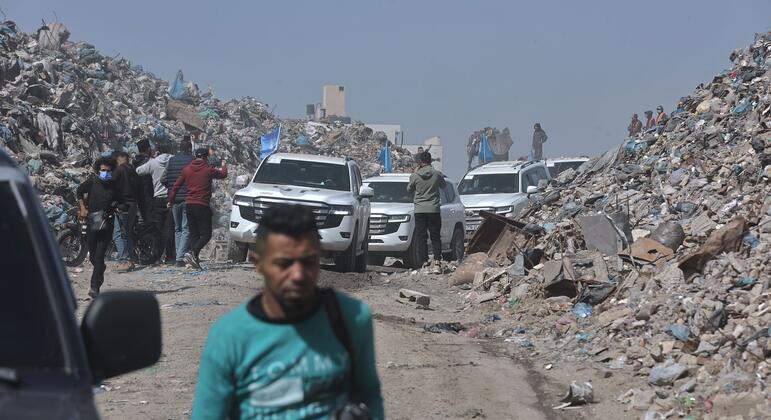
Speaking to the media in Jerusalem at the end of a three-day trip to Gaza and the West Bank, De Croo – formerly Belgium’s development minister – said the living conditions he saw were the worst he had ever encountered. According to him, only 0.5 percent of the rubble in Gaza has been cleared so far.
“At the current rate, it will take us seven years to remove all the rubble,” he said. “We need to increase our capacity to clear and process the rubble.” Today, 90 percent of Gaza’s population lives among these rubbles, which is extremely dangerous.”
The vast majority of the enclave’s residents still live in primitive tents, which UNDP is beginning to replace with modular residential blocks. Currently, 4 thousand such objects are ready, but the population needs up to 300 thousand.
“We understand the security concerns of the Israeli authorities,” De Croo emphasized, “but this should not serve as a basis for denying access to organizations such as the UNDP, other UN agencies and international non-governmental organizations.”