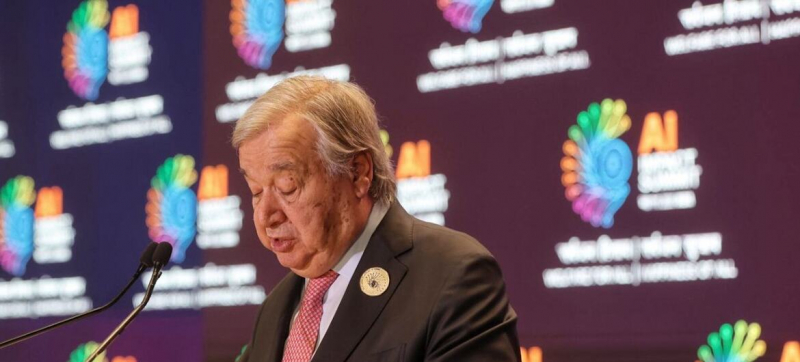

UN Secretary-General Antonio Guterres at the AI Impact Summit in India. UN Secretary General calls for $3 billion to ensure fair access to AI Sustainable Development Goals
The future of artificial intelligence “cannot be determined by a handful of countries or dependent on the whims of a few billionaires.” This was stated by UN Secretary-General Antonio Guterres, speaking on Thursday at the AI Impact Summit in New Delhi, India. He called for a $3 billion global fund to expand developing countries’ access to artificial intelligence technologies.
Without investment in skills development, data infrastructure, affordable computing power and inclusive digital ecosystems, many states risk being left behind in the era of AI, according to the UN chief.
“Our goal is 3 billion dollars. That’s less than one percent of a single technology company’s annual revenue,” Guterres noted, calling the amount “a small price to pay for the spread of AI that will benefit everyone, including the companies that create these technologies.”
The UN’s role in AI governance
The AI Impact Summit has been running since 2023. This year’s meeting is being held in a Global South country for the first time—previously hosted by France, the Republic of Korea and the United Kingdom.
The Secretary-General emphasized that the UN is taking steps to form a global AI governance system. In particular, last year the General Assembly established the Independent International Scientific Panel on Artificial Intelligence.
Its composition included 40 leading experts from around the world. Their mission is to provide independent assessments of the risks, opportunities and social impact of AI.
“AI must belong to everyone,” the UN chief said, calling on states, representatives of the private sector and civil society to actively support the work of the group.
Potential and risks
Guterres noted that when used responsibly, AI can help achieve the Sustainable Development Goals: accelerating medical discoveries, expanding access to education, strengthening food security, strengthening climate action and improving public services.
At the same time, he warned of risks: without proper regulation, AI has the potential to increase inequality, perpetuate bias and cause harm.
“We need protection mechanisms that ensure human participation and maintain control and responsibility,” the Secretary General emphasized.
He also drew attention to the growing needs of AI for energy and water, noting that the development of data centers must occur with the transition to clean energy sources and without harming local communities.
“We must invest in people so that AI enhances human potential, not replaces it,” he said.
The Secretary General emphasized the need to protect children and other vulnerable groups from exploitation and abuse.
“No child should be subjected to testing related to the uncontrolled use of AI,” he said.
In conclusion, the UN chief called for the creation of technologies that “improve lives and protect the planet,” emphasizing: “Let’s create an AI for everyone where respect for dignity is the default setting.”