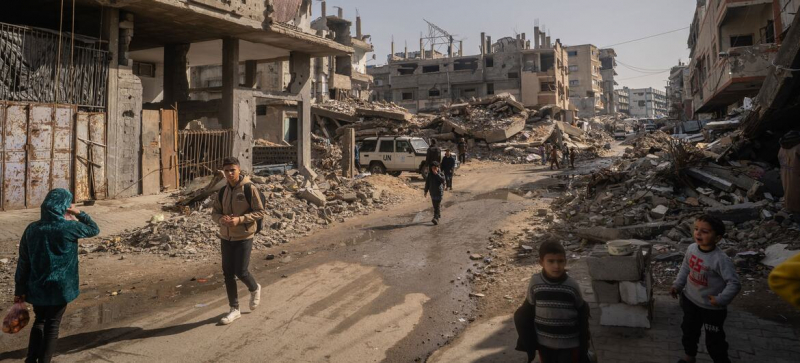

Destroyed areas of Gaza. Even war has rules: how civilians are protected during conflicts International law
When conflict breaks out, it is civilians—especially women and children—who suffer the most. And this is despite a long-standing set of international rules designed to protect them.
What exactly are the rules in force during war and what happens when they are violated?
What international law says
∙ International humanitarian law sets clear restrictions on the conduct of hostilities, and all parties to the conflict are obliged to comply with them.
∙ International humanitarian law is enshrined in the four Geneva Conventions of 1949, which have been ratified by almost all countries. In 1977, Additional Protocols to the conventions were adopted to protect victims of armed conflicts.
∙ Civilians and civilian infrastructure, including hospitals, schools and places of worship, are protected by international law.
∙ Civilians and civilian objects should never become targets of attack. Strikes can only be carried out against military targets and combatants (those who are directly involved in hostilities).
Why is this important
Due to conflicts, civilians die, are injured and injured, and flee their homes. People have no opportunity to receive medical care, children and youth cannot study. Conflicts also lead to famine and disease outbreaks.
Parties to a conflict are required to take all possible measures to avoid causing harm to civilians, or at least to minimize it – even if this means refraining from striking military targets.
What awaits civilians caught in the conflict zone?
When civilians are caught in the middle of hostilities, warring parties have a responsibility to ensure the rapid and unhindered delivery of humanitarian assistance, including that provided by the United Nations and its partners.
They also have a responsibility to respect and protect all humanitarian workers, including UN and associated organizations.
What happens when the rules are broken?
Serious violations of international humanitarian law during a conflict are considered war crimes.
The Hague-based International Criminal Court (ICC), established in 2002 under the Rome Statute, has jurisdiction to try serious violations of international humanitarian law. The ICC is not a UN agency.
The ICC Prosecutor may initiate investigations into cases referred by the UN Security Council, as well as requests from States Parties to the Rome Statute or based on information from reliable sources.
In the past, the UN has created special mechanisms to address such violations – for example, in relation to events in Rwanda and the former Yugoslavia.