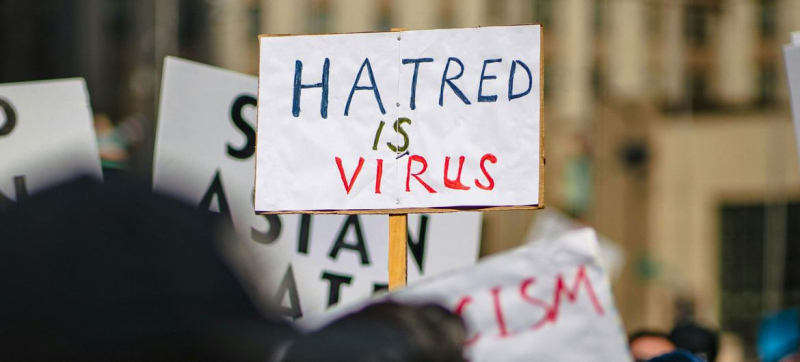

Demonstration against racism. One protester holds a banner that reads “Hate is a Virus.” Guterres: Racism remains a global threat and is spreading rapidly in the digital environment Human rights
“69 people were killed when police opened fire indiscriminately on a crowd peacefully protesting against apartheid,” UN Secretary-General António Guterres began his speech marking the International Day for the Elimination of Racial Discrimination with this reminder of the Sharpeville tragedy.
A protest in South Africa on March 21, 1960 ended in the mass shooting of unarmed demonstrators, which caused a wave of outrage throughout the world. The UN Security Council, in resolution 134, condemned the actions of the South African government. The UN Secretary General emphasized that the memory of this tragedy remains an important symbol of the fight against racism.
Learned behavior
The UN chief noted that racial discrimination is a direct violation of human rights. According to him, racism is not an innate, but an acquired quality.
“This is a learned behavior that is widespread and has devastating consequences,” Guterres said.
He emphasized that the consequences of racism are still felt today – in the legacy of slavery, colonialism and oppression. They are also reflected in economic, social and political inequalities.
“Racism lies at the heart of the abhorrent actions of white supremacists and other extremist groups. It sows mistrust, divides society and deprives people of their human dignity,” the UN chief said.
Hate in the digital environment
Today, according to the Secretary General, the spread of hatred in the digital environment is of particular concern. New technologies, he noted, contribute to the spread of misconceptions and stereotypes, which often lead to violence in real life.
The Secretary-General also expressed concern that xenophobia and racism are increasingly becoming part of political discourse and being normalized in the public space.
“I am deeply concerned about how racism and xenophobia are becoming mainstream on digital platforms and in political discourse,” he said.
Guterres emphasized the need for joint action by states, business and society: “Let us fight for the dignity, rights and sense of belonging of every person. And together we will vow to erase the stain of racism from our world,” said the Secretary General.
Under the guise of everyday life
Racism still exists in all corners of the world and takes many different forms, noted the President of the UN General Assembly, Annalena Burbock, in her speech.
“Sometimes it manifests itself clearly and vulgarly – in the form of insulting words hurled at another person, or graffiti scrawled on a wall,” she said.
“Sometimes it manifests itself quietly and unnoticed, hiding under the guise of bureaucracy and hiding behind everyday life,” Burbock added.
But whatever form it takes, racism has devastating consequences for the entire society, and not just for individuals, she emphasized.
Breaking down barriers
“Let’s not kid ourselves: we may not be segregating people by race on buses anymore, but all too often We still do this in our thoughts and way of life,” said UN High Commissioner for Human Rights Volker Türk.
Around the world, people of African and Asian descent, Jews, Muslims, indigenous peoples and other ethnic, religious and cultural minorities continue to face discrimination, stigmatization, hatred and dehumanization, he stressed.
“By questioning our preconceptions, checking facts, and studying history and human rights, we can see clearly, despite distraction tactics, and realize our common humanity,” Turk said.
He called for us to together destroy the barriers that limit people, “until they disappear completely.”