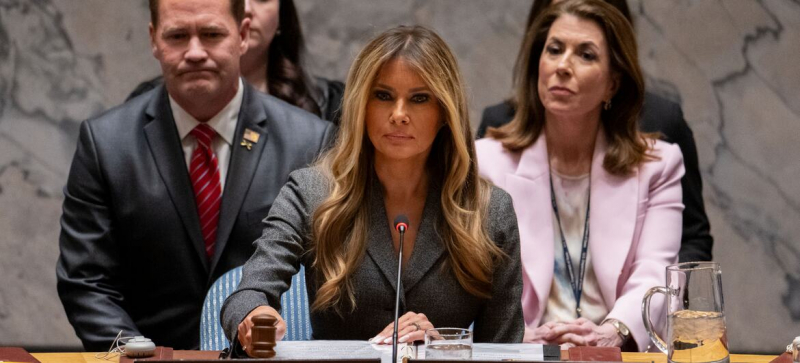

Melania Trump, First Lady of the United States, presides over a meeting of the UN Security Council. UN Security Council: protecting children in conflict requires urgent action in education and technology Peace and security
The UN Security Council met on Monday for a meeting on the topic “Children, technology and education in conflict.” The meeting was opened by Melania Trump, First Lady of the United States of America, the country that holds the rotating presidency of the Security Council in March.
Speaking to members of the Security Council, Under-Secretary-General for Political Affairs Rosemary DiCarlo warned that one in five children in the world – 473 million children – live in a conflict zone or are forced to flee war.
DiCarlo recalled that the number of armed conflicts in the world has reached its highest level since World War II. According to the UN, the number of serious violations against children verified by the organization increased by 25 percent between 2023 and 2024. Rape and other forms of sexual violence increased by 35 percent.
The deputy UN chief noted that in recent days, schools in Israel, the United Arab Emirates, Qatar, Bahrain and Oman have been closed and switched to distance learning due to military operations in the region. There were also reports that possibly dozens of children were killed in an attack on an elementary school in the city of Minab in Iran.
Education as a life saver
Conflicts deprive the younger generation of access to education and prospects for the future, DiCarlo emphasized.
“In situations of violence, schools are often the only safe space,” she noted. Education protects children from recruitment, trafficking and exploitation, and ensures access to hygiene, psychosocial support and other basic services.
However, educational infrastructure continues to come under attack. In 2024, the UN verified 2,374 attacks on schools and hospitals. The largest number of attacks were recorded against educational and medical facilities in Ukraine, Israel, the occupied Palestinian territory and Haiti.
DiCarlo recalled Security Council Resolution 2601 (2021), which calls on parties to conflicts to immediately stop attacks on schools, children and teachers and respect the right to education in accordance with international humanitarian law.
The speaker also paid tribute to the First Lady of the United States for her work in drawing attention to the problems of children in conflict, and “especially for her personal involvement in reuniting Ukrainian children with their families.”
Technologies as a tool for access to learning
With infrastructure destroyed and teachers in short supply – with 44 million teachers missing in conflict zones – digital technologies can be an important tool for ensuring lifelong learning, a UN spokeswoman said.
She gave examples of initiatives by the Organization and its partners. For example, the Learner Passport, developed by UNICEF and Microsoft, provides 10 million children in 47 countries with access to a mobile learning platform.
Another program, run by the Vodafone Foundation and the UN Refugee Agency, provides internally displaced people and teachers with access to digital educational content in the Democratic Republic of the Congo and South Sudan. In Afghanistan, UNESCO is using digital technologies to provide learning at home and in communities where 2.2 million girls are excluded from education.
Risks in the digital environment
At the same time, DiCarlo emphasized that technology also carries risks. Children in conflict settings are particularly vulnerable to online threats – exploitation, human trafficking, radicalization, recruitment into armed groups and cyberbullying.
She called for strengthening legal and policy mechanisms for protecting children’s rights in the digital space in accordance with international law, and also emphasized the special responsibility of technology companies to ensure the safety of users, especially children and youth.
Conflict prevention is the main defense
Of additional concern is the decline in funding: funding for education in emergencies has fallen by 24 percent, despite growing needs. DiCarlo emphasized that the most effective way to protect children is to prevent and stop wars.
“Building peace is at the core of what the United Nations does,” she said. “We must work together to achieve this goal.”
Melania Trump called for promoting ideas of peace through education and technology
Speaking at the UN Security Council, First Lady Melania Trump called on world leaders to prioritize education and access to technology as the basis for lasting peace and global security.
Opening her speech with words of condolences to families who have lost loved ones in conflicts around the world, she expressed solidarity with the wounded and emphasized support for children affected by war. “The United States stands with all children around the world,” she said.
Trump stressed that sustainable peace depends on knowledge and understanding, warning that societies that restrict access to education risk instability and conflict. Calling education a fundamental human right, she noted that when children are deprived of the opportunity to learn, society has to pay a heavy price for it.
She also highlighted the transformative role of artificial intelligence and digital access in democratizing knowledge and called on countries to bridge the technology divide.
“The path to peace depends on empowering our children through education and technology,” she concluded.
France – on the use of technology by armed groups
French Ambassador to the UN Jerome Bonnafon thanked the First Lady of the United States for her mediation role, which facilitated the return of Ukrainian children forcibly deported to the Russian Federation. He also noted that Russian drone attacks have an extremely negative impact on the lives of children in Ukraine.
“Today’s debate is the focus of the Security Council,” he said, calling on the Council to prevent the use of new technologies to undermine international security.
According to the diplomat, they are increasingly being used by armed groups, which leads to increased violence. Because of this, children suffer first, he said.
Bonnafon stressed that, in coordination with all stakeholders, the Council must continue its work within the framework of the agenda on children and armed conflict, as well as youth, peace and security.
Russia stands up for the protection of children
Russia’s Permanent Representative to the UN, Vasily Nebenzya, said that his country “consistently advocates for ensuring comprehensive protection of minors and respect for the civilian nature of educational infrastructure.” According to him, the Russian Armed Forces strictly adhere to the norms of international humanitarian law when conducting military operations.
At the same time, he said that children in the Belgorod region were forced to study online due to attacks last year, and in the last week alone, Russian schools “became the subject of attacks by the Ukrainian armed forces five times.”
He called reports of 20 thousand abducted Ukrainian children a “disinformation, false and disgusting campaign,” emphasizing that Russia is working to reunite minors with their families who have lost contact as a result of the conflict. “We are being assisted in this process by Qatar, the International Committee of the Red Cross and the Vatican,” Nebenzya added.
He noted that the Russian side highly appreciates the personal efforts of the First Lady of the United States “on this issue in the context of the situation around Ukraine.” “[We] continue to maintain constructive interaction through our children’s ombudsman and look forward to further fruitful cooperation,” the diplomat said.