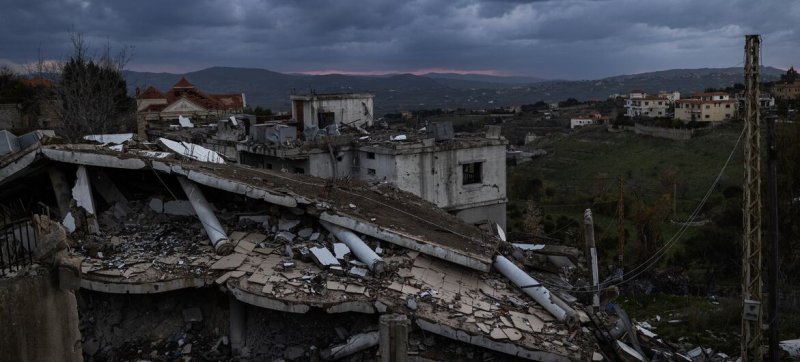

Destroyed buildings in southern Lebanon. Nearly a million people have fled their homes as Lebanon’s crisis escalates. Peace and security
UN humanitarian agencies are recording a sharp rise in the number of displaced people in Lebanon, where ongoing fighting and attacks on densely populated areas are forcing people to flee their homes in droves.
According to the International Organization for Migration (IOM), more than 822 thousand Lebanese are officially registered as displaced persons. About 128,000 people are sheltering in 600 government-run centers, many of which are already overcrowded. Mathieu Luciano, head of IOM’s Lebanon office, warned that needs are growing faster than the capacity of humanitarian response structures. Families continue to flee airstrikes and instability, and recent shelling of displaced areas, including Beirut, has exposed the extreme vulnerability of people forced to live in tents and temporary shelters. The International Organization for Migration and its partners are distributing food, mattresses, blankets and medical assistance to those in need.
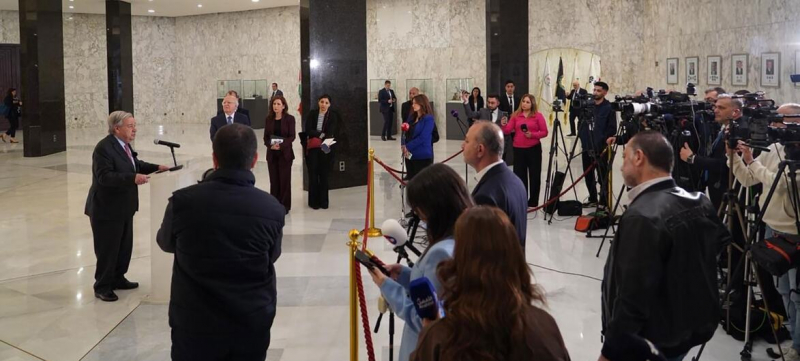
Briefing with the participation of the UN Secretary General in Beirut.
UN Secretary-General arrived in Beirut
Against the backdrop of a rapidly deteriorating situation, UN Secretary-General Antonio Guterres arrived in Lebanon. His visit followed new Israeli strikes against Hezbollah targets in the Beirut area. The Secretary General arrived in Lebanon from Turkey, where the day before he received the Ataturk International Peace Prize. Upon arrival, Guterres said that he had come to express solidarity with the people of Lebanon. The UN chief stressed that the Lebanese “did not choose this war – they were dragged into it.” The Secretary-General said that the UN will make every effort to achieve the peace “that Lebanon and the entire Middle East region deserve.”
The plight of children
The United Nations Children’s Fund (UNICEF) says the escalation has left at least 91 children dead and another 275 injured. Among the more than 816,000 displaced people in Lebanon are nearly 286,000 children. Mass evacuations are sweeping the southern suburbs of Beirut, the northern Bekaa and all areas south of the Litani River, affecting about half a million residents. Due to overcrowding in shelters, many families are sleeping in cars or in the open air. More than three hundred public schools have been converted into temporary accommodation centers for internally displaced persons, which has deprived more than 110 thousand schoolchildren of the opportunity to study.
The situation in southern Lebanon
The situation in the south of the country remains extremely tense. According to the UN peacekeeping mission in Lebanon (UNIFIL), after an intensive exchange of missile and artillery strikes two days ago, the situation has somewhat stabilized, but fighting continues. Mission representative Candice Ardiel said that Israeli forces had gone seven kilometers deep into Lebanese territory. At the same time, rocket and artillery attacks, as well as drone strikes, continue on Israel and the occupied Golan. Lebanese authorities say nearly 700 dead and about 1,800 wounded as of March 12.
The war affected labor migrants
Labor migrants were also involved in the growing regional crisis. Lebanon is home to about 200,000 foreign workers employed in agriculture, construction or the service sector. According to UN estimates, at least 30 thousand of them were forced to leave their homes. Some of them cannot or do not want to go to official placement centers. In total, there are almost 30 million migrant workers in the Middle East, including Iran, where many Afghans live. Women are forced to give birth on the streets
Women forced to give birth on the street
The United Nations Population Fund (UNFPA) warns of a sharp deterioration in access to health care in Lebanon. The agency is asking for $12 million to provide life-saving support to 225,000 people, including thousands of pregnant women. Due to destroyed infrastructure and lack of emergency assistance, some women are forced to give birth on the streets. According to UNFPA estimates, about 280 thousand women of reproductive age are at high risk, including 11,600 pregnant women.