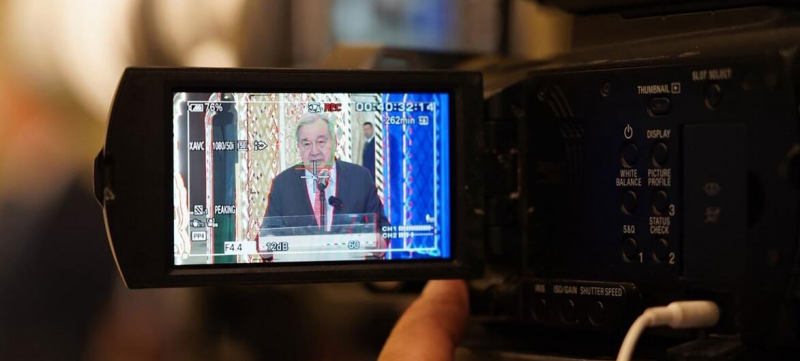

UN Secretary-General Antonio Guterres speaks to the media in Beirut, Lebanon. UN Secretary General in Lebanon: $308 million needed for emergency assistance to Lebanese Humanitarian assistance
UN Secretary-General Antonio Guterres, who is visiting Lebanon, has launched a campaign to raise $308.3 million in emergency humanitarian funding to support the country’s population. The escalation of violence in the region has led to widespread destruction, civilian casualties and mass displacement of people.
Guterres arrived in Beirut on Friday, calling his trip “a visit of solidarity with the people of Lebanon.” In his speech, the UN chief emphasized that “solidarity in words must be accompanied by solidarity in deeds.”
Humanitarian priorities
According to the Secretary-General, the military escalation in the region is having a devastating impact on Lebanon. Hundreds of civilians died, many of them children. Entire communities were forced to flee their homes and people’s lives were completely disrupted.
The country’s evacuation zones have expanded significantly, and access to food, water, medical care, education and other basic services has been severely disrupted.
According to the UN, more than 816 thousand people have been displaced inside Lebanon, and over 90 thousand people – mostly Syrians, but also Lebanese – have crossed the border into Syria.
Efforts to help
Despite the difficult situation, the UN head noted the manifestations of solidarity and mutual assistance within the country. Schools are opening their doors to accommodate displaced families, health workers continue to work under enormous pressure, and communities are showing extraordinary resilience in the face of enormous disruption.
UN agencies and humanitarian partners are working with national authorities to deliver hot meals, drinking water, hygiene products and basic necessities.
“These efforts are saving lives, but they urgently require much more support,” the Secretary-General noted.
Additional funding
The funds requested by the UN are for three months and will be are aimed at expanding life-saving assistance, including food, clean water, health services, education, civilian protection and other essential services.
The success of the operation will depend on fast and flexible funding, as well as ensuring safe access for humanitarian workers to people in need.
Guterres also recalled that the aggravation occurred during significant periods from a religious point of view: Ramadan for Muslims and Lent for Christians. Both religions instruct their followers to show compassion and support each other.
For many years, Lebanon has welcomed people fleeing conflict, showing the world the true meaning of hospitality and solidarity, the UN chief said. “Now, in this hour of grave danger and great need, the world must stand with the people of Lebanon,” he said.
Ceasefire and negotiations
The Secretary-General also stressed the need for an immediate ceasefire, which should create conditions for negotiations and allow Lebanon to restore territorial integrity and strengthen state institutions.
Earlier on Friday, he held meetings with Lebanese President Joseph Aoun, Parliament Speaker Nabih Berri and Prime Minister Nawaf Salam. The Secretary General confirmed the UN’s strong support for the territorial integrity and sovereignty of the country.
Discussions also focused on the full implementation of Security Council resolutions 1559 and 1701, including strengthening security and stability in the Blue Line area separating Lebanon and Israel.