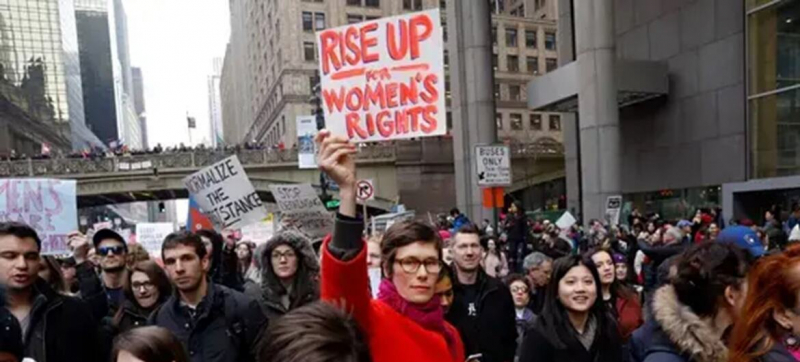

Demonstration in support of women’s rights in 2017 in New York. No country in the world has achieved full legal equality of the sexes. Women
The justice system designed to ensure rights and the rule of law is failing to protect women and girls. The UN reported this on the eve of International Women’s Day. Globally, women have only 64 percent of the legal rights that men have.
A new report by the UN Secretary-General reveals that in more than half the world’s countries, rape is still not defined based on the principle of consent. Thus, a woman may be raped, and the law, for one reason or another, may not recognize the incident as a crime.
A girl can still be forced into marriage under national law in almost 75 percent of countries. And in 44 percent of countries, the law does not require equal pay for work of equal value, meaning a woman may receive less for the same work.
“When women and girls are denied justice, the harm goes far beyond any single case. Public trust is undermined, government institutions lose legitimacy, and the rule of law is weakened. A justice system that fails half the population cannot claim to deliver justice,” said UN Women Executive Director Sima Bacchus.
All over the world there is an increase in the number of violations of the rights of women and girls – in courts, on the Internet, in conflict zones. Laws are being rewritten to limit the freedoms of women and girls and allow abuse without consequences.
As technology advances rapidly, women and girls face growing digital violence in a climate of impunity. In conflict settings, rape continues to be used as a weapon of war, with reported cases of sexual violence increasing by 87 percent in the past two years.
The UN Secretary-General’s report also shows that progress is possible: 87 percent of countries have passed laws against domestic violence, and more than 40 countries have strengthened constitutional protections for the rights of women and girls over the past decade.
However, laws alone are not enough, the UN emphasizes. Discriminatory social norms, stigma, victim-blaming, fear and social pressure continue to silence survivors and obstruct justice, allowing even the most extreme forms of violence, including femicide, to go unpunished.
Women’s access to justice is also often limited by everyday realities – cost, lack of time, mistrust of the institutions that are designed to protect them.
On the eve of International Women’s Day, UN Women calls for an end to impunity and to ensure the rule of law and equality – not only in the legal sphere, but also in practice, in all spheres of life.
The seventieth session of the Commission on the Status of Women, which this year will take place from 9 to 19 March, represents a unique opportunity to draw attention to the problem of discrimination against women and ensure justice.
“Now is the moment to stand up and speak up – for rights, for justice and for action, so that every woman and every girl can be safe, speak freely and live as equals,” said UN Women Executive Director Sima Bacchus.