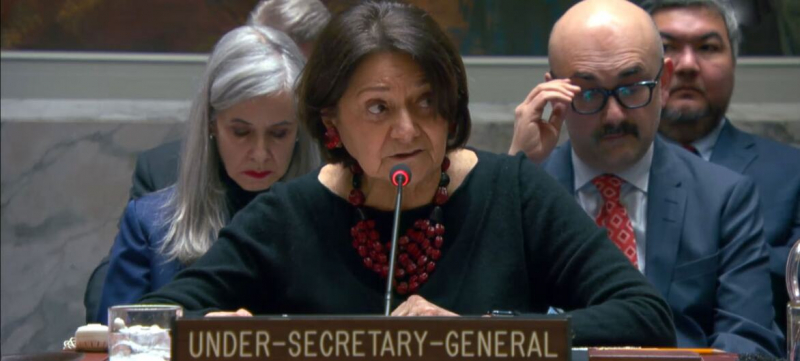

UN Deputy Secretary-General Rosemary DiCarlo speaks at a meeting of the UN Security Council. The Security Council discussed energy, critical minerals and security issues Peace and Security
The meeting, which was opened by US Energy Secretary Chris Wright, was one of the key meetings for the United States presidency of the Security Council in March. The concept note, which the American side distributed among Security Council members, states that the Council is invited to study the extent to which competition for resources affects the security situation in the world.
Speaking on behalf of the Secretary-General, UN Deputy Chief of Political and Peacebuilding Affairs Rosemary DiCarlo said that the rapid growth in demand for key resources for the 21st century creates unique opportunities for development, but at the same time increases geopolitical tensions.
Minerals such as lithium, cobalt, nickel and rare earth elements have become the basis of the digital economy and the energy transition, she said. In 2023, global trade in raw and semi-processed minerals reached $2.5 trillion, representing more than ten percent of global trade. Projections indicate that demand could triple by 2030 and quadruple by 2040.
DiCarlo emphasized that this growth opens up enormous opportunities for producing countries, from job creation to economic diversification. At the same time, it increases competition for resources, provokes human rights violations and damages the environment.
The relationship between conflicts and resource extraction
The Deputy Secretary General recalled that the production of critical minerals is geographically concentrated in several places and many key producers are in conditions of instability. More than 70 percent of global cobalt production comes from the Democratic Republic of the Congo, Myanmar remains one of the largest sources of rare earth elements, and Ukraine has significant reserves of titanium and lithium. In the context of war and conflict, DiCarlo noted, uncontrolled mining undermines governance, fuels underground economies and funds armed groups.
The Security Council has repeatedly recognized the link between natural resources and conflict, imposing sanctions against the illegal trade in raw materials in the DRC, Libya and the Islamist group Al-Shabab. UN experts help identify violations, track supply chains and stop illegal exploitation.
Particular attention is paid to the African Great Lakes region, where control over deposits directly affects the dynamics of the conflict. According to the UN, the AFC/M23 rebel coalition in DR Congo earns more than a million dollars a month from illegal mining and smuggling of minerals. Together with the DRC authorities and regional partners, UN peacekeepers are working to reduce the influence of armed groups in mining areas, and the Secretary General’s special envoy is helping to strengthen mechanisms for transparency and shared resource management.
Three priority areas
DiCarlo outlined three areas that, in her opinion, should become priorities – in order for countries experiencing conflicts, could harness the potential of critical minerals to benefit themselves and the international community.
First, she said, mining must produce fair and equitable results, and this requires strengthening government institutions, improving regulation and increasing the ability of states to negotiate beneficial agreements. Secondly, international and regional efforts are needed to strengthen governance systems, improve transparency and sustainability of supply chains, and dialogue between producing and consuming countries. Third, diplomatic tools must be used to prevent and resolve resource disputes.
Concluding her speech, DiCarlo emphasized that the responsible and fair use of critical minerals can lift hundreds of millions of people out of poverty and become a factor in peace, not conflict. For this, she said, coordinated actions of states, business, civil society and the entire UN system are needed.