

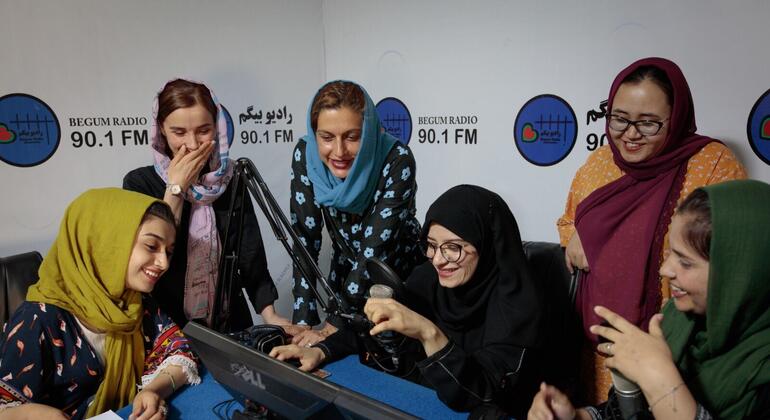
The UNESCO-supported radio station has a team of about thirty women. Begum Station: A Lonely Female Voice on Afghanistan’s Patriarchal Radio Cristina Silveiro Women
Every morning, several cars wander for a long time through the narrow streets of Kabul to pick up employees of the Begum radio station for work. Young women can no longer get to the office on their own; moving around the Afghan capital alone has become too uncomfortable for them.
“They cannot come on their own – neither by bus nor by taxi. Today it is incredibly difficult for a woman, especially a young woman, to move around the city,” the radio station’s founder, Hamida Anan, told UN News Service.
The UNESCO-supported radio station has a team of about thirty women. Begum broadcasts almost throughout the country – with the exception of several provinces, where the authorities have banned even the very sound of a woman’s voice on the radio.
“Today in Afghanistan, when you change TV channels or listen to the radio, you only hear male voices and see only men,” says Hamida.
In the sound space where patriarchy reigns, radio Begum sounds fresh and unusual.
Radio created by women for women
Radio Begum started broadcasting in March 2021 – in just a few months until the Taliban returns to power in Afghanistan.
Hamida Anan was born in Kabul, but when she was eight years old, her family took her out of the country. She was raised and educated in Switzerland, where she studied journalism. After the fall of the Taliban regime in 2001, she returned to her homeland to help develop the Afghan media.
In the first months, the station broadcast music, entertainment programs, as well as interviews with active and successful women, but after August 2021, it had to rapidly change content: first, the editors were forced to stop playing music, then to reduce entertainment programs.
The restrictions multiplied every month. Women were gradually forced out of government positions; female journalists had to work under strict restrictions: they could only interview women and had no right to be alone in the studio with a man.
“Warnings and threats became the norm,” Anan recalls.
To continue operating, the station decided to avoid political topics.
At the end of 2024, the Taliban issued a decree declaring “inappropriate” the sound of a woman’s voice in public places. In several provinces, this led to a complete ban on women’s voices in radio and television broadcasts.
“We are no longer an ordinary media outlet, but a radio serving the interests of women,” says the founder of the radio station.
The editors gradually rebuilt the broadcast network, focusing on education. The station began broadcasting lessons long before the ban on girls’ education became widespread. When schools closed for good, this mission became paramount.
“Yes, schools have been closed, but education is not prohibited yet. So, as far as possible, we will bring school to every home,” says Hamida.
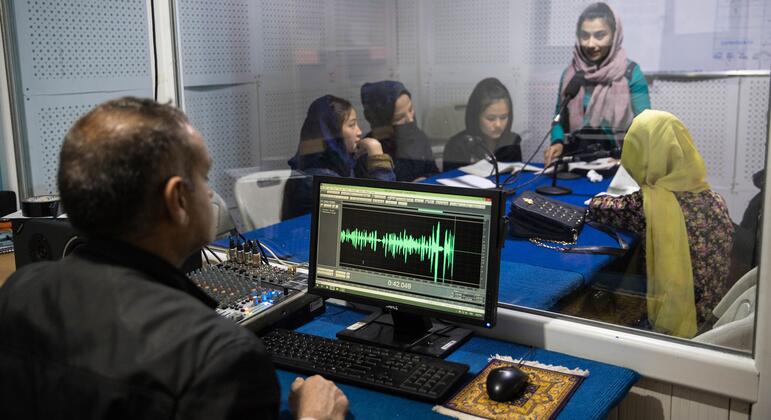
Today, the station broadcasts six hours of educational programs daily, based on the previous school curriculum. Three hours of broadcasting are in Dari, the other three in Pashtun.
The station also produces programs about health, provides psychological support, gives medical advice, talks about women’s entrepreneurship and social issues. Most programs are live broadcasts, where listeners can call to ask their questions.
Promoting women’s rights through Islam
To be able to talk about women’s rights, Begum radio chose an unexpected strategy, relying on religious texts.
“We tell women about their rights and we do it through Islam because that’s the only way right now,” explains Hamida.
The station’s religious program is based on verses, surahs and hadiths, which are explained on air by female theologians.
“Islam is very clear about the place of women in society,” Hamida notes, citing examples of religious interpretations of rules on inheritance, divorce, the status of widows and education.
On air, the presenters quote the texts verbatim: “We read out the verses, suras… so that no one can object.”
At first, the authorities carefully monitored the broadcast to make sure that the presenters correctly understood religious canons. The reaction was unexpected: “They told us that this was their favorite program. Today she is one of the most popular at the station.”
“The best popularity barometer”
We receive a lot of calls from all over the country.
“Calls from listeners are the best barometer of our popularity,” says Hamida.
One woman said that she learned from the air about her rights to inheritance and was then able to defend them in a family dispute. Another woman reported that the program changed her husband’s behavior: “He listened to several broadcasts and has since become much kinder and more attentive to me.”
Such stories, Hamida says, maintain a professional attitude and “give a little comfort.”
Despite the pleasant small victories, the reality remains difficult.
“Being an Afghan woman means living under a lot of restrictions and with constant anxiety,” says Hamida. “We are filling the gaps in the work that the government should be doing, but it ignores the interests of 50 percent of the country’s population, and we were forced to fill an empty space.”