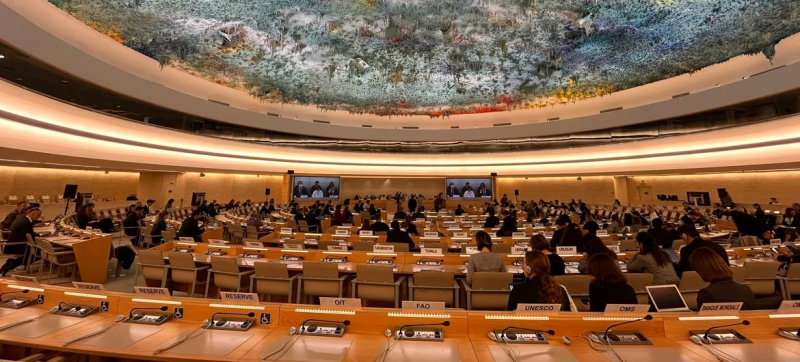

Meeting room of the UN Human Rights Council. Ukraine: The Independent International Commission presented its new report International law
The Independent International Commission of Inquiry into Violations of Ukraine presented its new report at the 61st session of the UN Human Rights Council. It said the commission continued its investigation into the deportation of Ukrainian children by Russian authorities to the Russian Federation or to occupied areas of Ukraine.
Deportation of Ukrainian children to the Russian Federation
“Convincing evidence of the deportation and transfer of a total of 1,205 children from five regions of Ukraine, verified by the commission, allowed it to conclude that these actions are crimes against humanity and war crimes in the form of deportation and forced transfer of children,” the report notes.
The report’s authors claim that Russian authorities systematically failed to report the children’s whereabouts to their parents or legal guardians and prevented their return. Instead of creating a system to facilitate the return of children, the authorities sought their long-term placement with families or appropriate institutions in the Russian Federation.
“Throughout 2022, Russian authorities have stated that adoption is the preferred placement option for these children. Therefore, the Commission also concluded that the Russian authorities committed a crime against humanity in the forced disappearance of children deported or displaced from Ukraine, as well as a war crime in the unjustified delay in their repatriation,” the report says.
According to the commission, 80 percent of children have not yet returned from Russia, others have encountered obstacles and delays. Many parents and legal guardians remain unaware of the fate and whereabouts of their children and continue to search for them, the report’s authors say.
Lawsuits against Ukrainians
The commission also investigated the conduct of trials in the Russian Federation and in the territories of Ukraine it occupied. Ukrainian civilians and prisoners of war were mainly accused of terrorism, espionage and violent seizure of power.
“The commission found that these courts deprived the accused of fundamental guarantees of a fair trial and thereby committed serious violations of international humanitarian law that constitute war crimes,” the report notes.
“Russian authorities systematically used evidence fabricated or obtained through torture or ill-treatment to convict defendants,” the report’s authors say.
According to them, the courts did not respect fair trial guarantees and handed down predetermined sentences.
Cruel punishments in the Russian armed forces
The commission investigated the circumstances surrounding the recruitment of citizens of 17 countries to participate in hostilities on the side of the Russian armed forces.
“Many of them were deceived and lured from abroad with promises of civilian work or other favorable conditions. They were forced to sign contracts written in Russian, which they did not understand, and were sent on dangerous front-line missions,” the report says.
The commission also interviewed 85 soldiers who served in the Russian military and subsequently deserted. Most of them spoke about the brutal methods used by the commanders. In particular, punishments such as execution on sight, beatings and detention in a pit were used for refusing to participate in military operations that would lead to certain death, or for retreating from the front line in case of injury or lack of supplies, the report said.
“This evidence demonstrates a complete disregard for human life and dignity and indicates that the use of violence against subordinates is widespread and systematic in the Russian military,” the report’s authors write.
Violations by the Ukrainian authorities
Members of the commission also noted that the definition of the crime of “collaboration” in Ukrainian criminal code has led to the prevalence of legal uncertainty. According to the authors of the report, activities that do not pose a threat to national security can also be interpreted as this crime.
The commission documented violations reported during mobilization into the Ukrainian armed forces. These include unlawful administrative detention, lack of access to a lawyer, and rushed examinations by military medical boards that ignore possible medical problems.
“There have been recorded cases of violence against conscientious objectors who were forcibly taken to recruiting stations and military units, despite the fact that they expressed their willingness to perform alternative civilian service,” the report says.