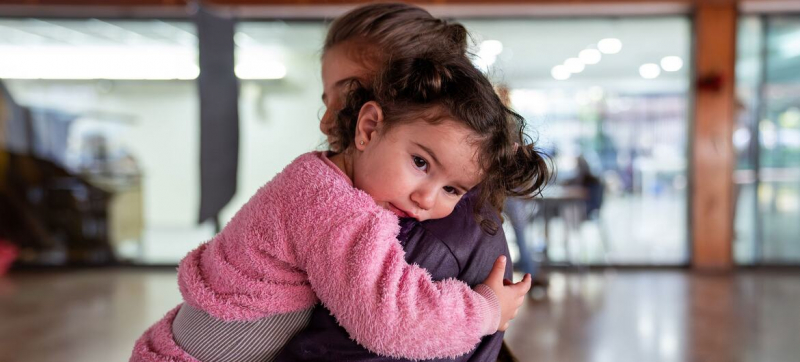

Tens of millions of people around the world need help. The photo shows a family in Lebanon. UN calls on the world to unite and save 87 million lives Humanitarian assistance
On Wednesday, UN Emergency Relief Coordinator Tom Fletcher unveiled a new global humanitarian campaign, 87 Million Lives. This is how many people will receive help under this initiative.
According to Fletcher, the world is going through a very dangerous time. Conflicts, especially in the Middle East, are rapidly escalating and increasingly intersecting with each other. The violence is causing new waves of displacement, economic disruption and a surge in humanitarian needs.
Fletcher made three requests to the international community. The first is to ensure the protection of all civilians and infrastructure, including schools, hospitals and energy facilities, and guarantee the safety of humanitarian workers.
“Civilians, all civilians, no matter where they are in the region, must be protected,” the Emergency Relief Coordinator said.
The second call concerns the access of humanitarian organizations to people in need of assistance, regardless of country or party to the conflict.
Third, Fletcher called for a renewed diplomacy based on a strategic, rational approach and a commitment to peace.
He also stressed that the humanitarian system is going through an extremely difficult period: aid workers are increasingly being targeted. Just today, he said, three aid workers were killed in Sudan, the Democratic Republic of Congo and Lebanon.
“This is a difficult moment for humanitarian work. We are overwhelmed, under constant attack and under-resourced, but we refuse to compromise our principles and our mission. We will not turn our backs on the people who count on us,” Fletcher said.
Against this backdrop, the UN presented a humanitarian plan for 2026. It provides $23 billion to help 87 million people. About 2,000 humanitarian organizations are involved in the implementation of the program, more than 60 percent of which are UN partners on the ground. Fletcher’s new campaign calls for the plan to be implemented.
Fletcher noted that already in January, more than 7 million people received assistance as part of 17 UN operations, including almost 2 million people in Sudan. If this level of assistance can be maintained monthly, the organization will be able to reach its goal of helping 87 million people in a year.
According to the coordinator, to date 5 billion dollars have already been allocated for the implementation of the plan, and taking into account the announced obligations – 8.7 billion, that is, more than a third of the required amount. The main donors were the USA, the European Commission, Sweden, Germany, Switzerland, Great Britain, Canada, Japan, Norway, Denmark, UAE, Belgium and Qatar.
However, the funding gap remains significant – more than $14 billion. Fletcher recalled that military operations in the Middle East cost about $1 billion a day, and even a small portion of this could save millions of people.
“We are not asking you to choose between a hospital in Brooklyn, London, Mexico City, Rio or Manila and a hospital in Kandahar, Akobo, Aleppo or Port-au-Prince. We’re just asking for recognition that maybe the world could spend a little less on weapons this year and a little more on doing something truly meaningful,” Fletcher said.