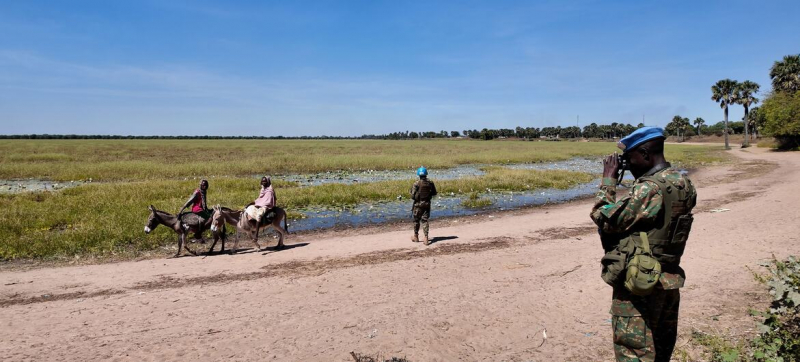

UN peacekeepers patrol the border between the Central African Republic and Sudan. Between war and instability: how communities live on the border of the Central African Republic and Sudan Alban Mendez de Leon Refugees and migrants
As you approach Birao, the landscape changes – the city, located on the Central African Republic’s northern border with Sudan, is surrounded by savannah, where the roads plunge into clouds of dust, and there are many more motorcycles than cars.
Two hours from Sudan, there is a region of a fragmented country that is practically isolated from the outside world, which is still trying to restore integrity, constantly feeling the echoes of the conflict raging in the neighboring state.
Since the start of the civil war in Sudan, tens of thousands of its residents have fled to the Central African Republic, taking with them not only what they were able to salvage from their homes, but also all the ills of the world’s largest humanitarian crisis.
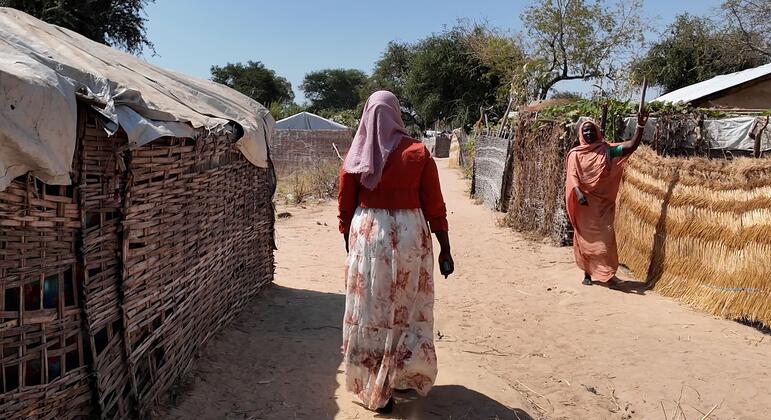
On a hot November day, at the beginning of the dry season, a tall woman greets us outside a plastic tent, among thatched houses in Corsi, a neighborhood hastily built on the outskirts of Birao to accommodate the endless stream of arrivals.
Nafisa, as we will call her here, said that she came from a suburb of Khartoum, the capital of Sudan, located more than a thousand kilometers away.
When war broke out in Sudan in April 2023, Nafisa and her family headed west to South Darfur, where her husband eventually opened a small market stall at the local market. One day, armed men burst into the store. They threatened, but he managed to escape. They chased him all the way home.
That same night, the attackers returned to finish what they started.
“They came at half past two in the morning,” recalls Nafisa, whose real name has been changed for security reasons. “He jumped out of bed and they shot three times.”
While the man was dying, the raiders tied up Nafisa and her nine-year-old son: “They took our money, things and clothes.”
She speaks in a quiet voice, her arms covered with exquisite henna tattoos, but her face bears the mark of grief and weariness caused by her long exile.
After the murder of her husband, Nafisa decided to leave Sudan with the rest of her family.
Heavy Tread of War
The tragic events that changed Nafisa’s life forever began after a breakdown in relations between the commander of the Sudanese army, General Abdel Fattah al-Burhan, and the commander of the paramilitary Rapid Reaction Force (RRF), Mohamed Hamdan Daghlo.
Over the course of three years, the internecine struggle for power in Khartoum escalated into bloody armed clashes throughout the country. About 30 million people found themselves in a situation of humanitarian catastrophe, more than 10 million fled their homes, half of them children. Since the summer of 2024, famine has reigned in many parts of Sudan.
In late October 2025, violence reached a new peak. After 500 days of siege, the Rapid Reaction Force captured the city of El Fasher, the last stronghold of the federal government in North Darfur. Hundreds of thousands of people were forced to leave their homes. There were reports of ethnic cleansing, massacres of non-Arab communities, rape and extrajudicial killings.
For many people in Darfur, this was a second wave of bloody violence. The Rapid Reaction Force was formed from the Janjaweed paramilitary unit, which fought for the Sudanese government during the war in Darfur more than two decades ago.
That conflict pitted the Janjaweed against non-Arab communities in the region. Just weeks before the fall of El Fasher, the International Criminal Court found former Janjaweed leader Ali Muhammad Ali Abd-Al-Rahman, known as Ali Kushayb, guilty of war crimes and crimes against humanity committed in West Darfur in 2003 and 2004. Prosecutors have warned that atrocities are resurfacing in the region today, with rape increasingly being used as a tool of war.
A land without borders
Like Nafisa, many impoverished Darfurians cross the border in the south of their country to enter the Central African Republic. They most often settle in Am Dafok, a border town located in a swampy area two hours’ drive from Birao.
There are no fences or border posts marking the end of one country and the beginning of another – only a dry riverbed stretching along the line that is plotted on the maps.
People move freely back and forth – on foot, on donkeys and with cattle. Armed people also cross the border unhindered.
According to Ramadan Abdel Kader, the region’s deputy governor, Am Dafok’s recent history has been marred by tragic events. “The population was in absolute despair,” he says. Armed men crossed the border daily to rob, kill and terrorize local villagers.
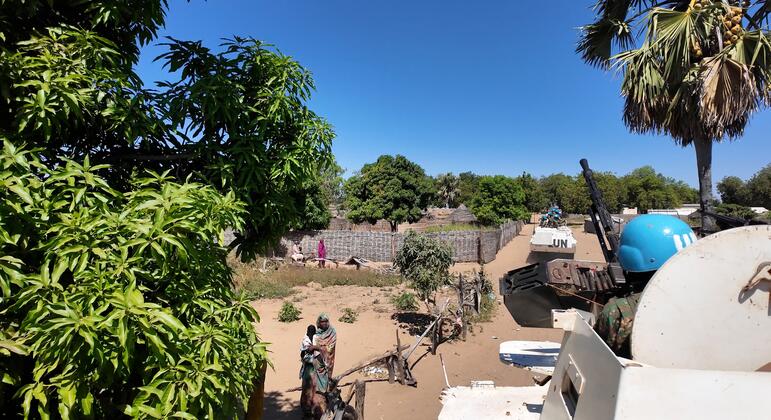
At the height of the violence, he said, up to 11,500 people – a significant part of Am Dafok’s population – fled their homes. They took refuge near a local base of MINUSCA, the UN peacekeeping mission in the Central African Republic, which has set up camp in the border town since the crisis began in Sudan. “If not for her presence here, this area would have been completely overrun by armed elements from Sudan,” the official says.
Born of another war
MINUSCA’s presence in the CAR is not directly related to events in war-torn Sudan. The mission was launched in 2014 as the Central African Republic descended into chaos following the seizure of power by the Seleka, the Muslim coalition that ousted President Francois Bozizé. These events were followed by a spiral of violence in which Séléka militants, as well as predominantly Christian militias known as the Anti-Balaka, committed widespread crimes against civilians – killings, looting, sexual violence – plunging the country into intercommunal bloodshed.
Violence brought the country to the brink of collapse. Entire communities were forced to flee their homes due to religious hostility. Fragile state power was limited to the capital.
Over the past ten years, Seleka has collapsed, the CAR has held two presidential elections, and a 2019 peace agreement brought 14 armed groups into the political process. Nevertheless, instability remains in large parts of the country. More than 13 thousand “blue helmets” continue to maintain order throughout the CAR.
In the north, where seasonal flooding regularly cuts off the region from the rest of the country, MINUSCA forces patrol vast areas with little infrastructure. “We are operating in an environment where the state is still rebuilding its institutions,” said Major Obed Mumba, commander of about 200 peacekeepers in Am Dafok. “Our role is first and foremost to protect civilians and prevent any escalation that could destabilize the region.”
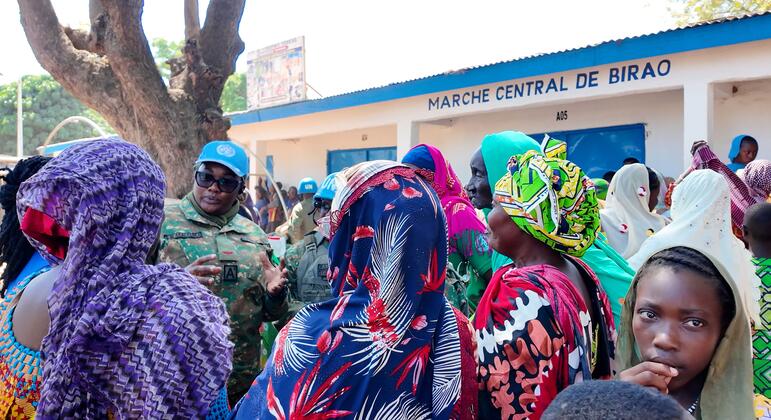
In connection with the current war in Sudan, the UN mission in the CAR has acquired new relevance. For Major Siphamwelwa Akalaluka, who leads MINUSCA’s community engagement efforts in Birao, the work is inseparable from the human element. “We interact with people every day,” she says. “We listen to women, youth, community leaders. This helps us understand where tensions are building before they turn violent.”
The subject of the dispute is land
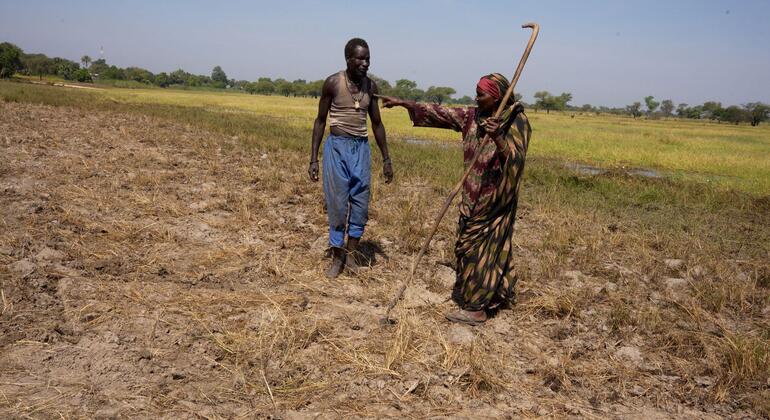
According to local residents, the tense atmosphere in these parts is caused not only by the presence of armed people crossing the border from Sudan. Mistrust is fueled by competition for land and resources between Sudanese pastoralists who fled violence in the Central African Republic with their herds, and Central African farmers whose fields lie along traditional transhumance routes.
When Sudanese herders moved their herds to the north of the Central African Republic, crops were trampled, the water in the wells dried up – and disputes flared up. The usual seasonal tensions escalated into confrontation, fueled by provocative rumors and the easy availability of weapons. The Rapid Action Force and other armed elements did not miss the chance to take advantage of the resulting chaos.
According to Tamia Celestine, one of the leaders of the Am Dafok community, the situation reached a critical point last September. “We have recorded numerous cases of rape,” he said. – They attacked girls and girls, some of whom were 12 or 13 years old. People were afraid to go to work in the fields.”
That month, six people were shot and killed in the county and there were 26 cases of sexual assault.
Dialogue in the clearing
In response to the deteriorating situation, MINUSCA established a cross-border dialogue, bringing together representatives of Central African and Sudanese communities. At the end of October, more than a hundred delegates gathered in Am Dafok. The meeting took place in the open air. People sat in a dusty clearing – on benches and rugs, in the shade of trees. There was no official room for the meeting.
“The dialogue was not easy,” recalls Tamiya Celestin, who took part in the three-day negotiations. “But the main thing is that people started talking to each other.”
Claims have been made. Accusations were made. In the end, everyone agreed that the violence must stop.
Two weeks before our arrival in Am Dafok, an agreement was signed. It prohibited the carrying of weapons, determined the routes for driving livestock, and obliged the parties to resolve disputes through dialogue at the level of local assemblies, and not through force.
Since then, according to Am Dafok residents, the shooting has largely subsided. The fields are being cultivated again. The border remains open, but the situation there is now calmer.
Am-Dafok these days was immersed in the pre-election bustle: residents were preparing to elect the first official mayor after several decades of anarchy – municipal elections have not been held in the country since 1988.
At the end of December, CAR citizens overwhelmingly voted for the current President Faustin-Archange Touadera, giving him a mandate for a third term.
Democratic elections promised the prospect of a normal life, which this region has been deprived of for many decades, but these hopes have not yet been destined to come true.
In search of safety
In 2023, Nafisa did not stay in Am Dafok, where she arrived with her family after the murder of her husband. The alarming situation at the border forced her, like thousands of other Sudanese trying to escape as far as possible from the war, to go to Birao.
The United Nations High Commissioner for Refugees (UNHCR) is working with local authorities to register new arrivals in Birao and help them survive in their new location. “They gave blankets and mattresses for me and my children,” she says. “Then they gave me the house we live in now.”
Today, more than 27 thousand Sudanese refugees live in Birao and its environs. This is a huge figure for a city whose indigenous population is less than 18 thousand people. “This is a rather unusual situation,” admits UNHCR official Geoffroy Fabrice Sangebe-Nadji. “The arrival of a significant number of refugees has placed an unsustainable strain on already stretched resources.”
In Korsi, where Nafisa and other refugees now live, humanitarian teams have created a special ecosystem. “It’s not even a camp,” explains Sangebe-Naji. “It’s a community where refugees live close to host people.”
Most of the inhabitants of Corsi continue to depend on humanitarian support – food, materials for housing, medical services and school education. “The main problem today,” says Sangebe-Naji, “is a critical lack of funding.”
Nafisa survives by selling everything she can find. “I was given a small stall at the local market,” she says. “Life is getting better little by little.”
However, the security situation still remains a problem. Although the Am Dafok agreement has eased intercommunal tensions along the border, violence still pervades people’s daily lives, including here in Birao. “The other day a boy was killed in the camp,” says Nafisa. “People got in there at night and killed him.” We couldn’t find his body.”
She does not plan to return to Sudan with her mother and children – at least in the near future. But a quiet stay in Birao is also not guaranteed. Without permanent protection and stable work, life in a foreign land remains a temporary solution.
So Nafisa is waiting. Her current situation is as fragile as the silence on the Sudanese border, but at least now her life and the lives of her children are not in danger.