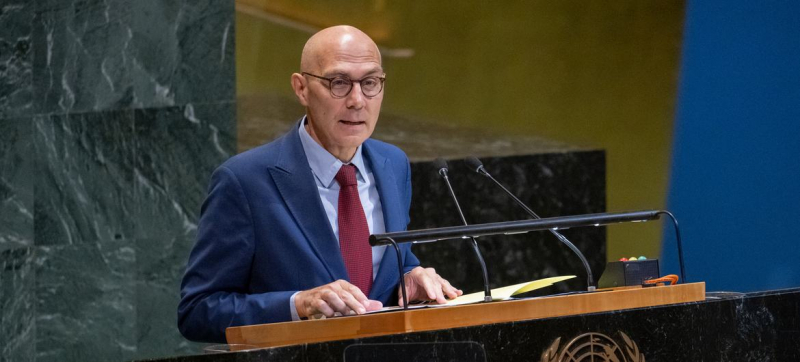

UN High Commissioner for Human Rights Volker Türk. Photo from the archive UN High Commissioner for Human Rights condemns US ‘harsh policies’ towards migrants Human rights
UN High Commissioner for Human Rights Volker Türk on Friday called on the United States to respect human dignity and the right to due process in its immigration policies and enforcement practices. He condemned the “dehumanizing portrayal” of migrants and refugees and the mistreatment of them.
Surveillance and detention
According to Turk, people are subjected to surveillance and detention, sometimes with violence, including in hospitals, churches, mosques, courts, markets, schools and even in their own homes – often only on the basis of suspicion of lack of proper documents. Children are missing school and pediatrician appointments for fear of never seeing their parents again.
“Routine abuse”
He also noted that officials vilify and intimidate those who dare to speak out against harsh immigration raids or protest peacefully. Sometimes, as Turk said in a statement, these people themselves are subjected to arbitrary violence.
The High Commissioner said he was appalled by the routine mistreatment of migrants and refugees and the disregard for their dignity and common humanity.
Turk emphasized that many of the migration measures currently being implemented by the US authorities lead to arbitrary and illegal arrests and detentions, as well as erroneous decisions on deportation. According to him, when applying these measures, there is often a lack of sufficient individual assessment of specific circumstances.
He acknowledged that states have the right to formulate national migration policies, but this must be done in full compliance with the law. Due process, he stressed, is critical to the legality and legitimacy of any policy. Failure to adhere to these principles undermines public trust, reduces legal certainty, weakens institutional legitimacy and violates people’s rights.
“Collective dehumanization of migrants”
The High Commissioner also noted numerous government officials, community and civil society representatives throughout the United States – members of Congress, judges, officials states and municipalities, as well as lawyers, clergy, social service providers, human rights defenders and ordinary citizens – who advocate for dignity, justice and accountability in the treatment of migrants and their communities.
He expressed deep concern about the “harmful and dehumanizing narratives” that are often used against migrants and refugees. Turk said the history of the United States has been shaped in large part by the contributions of migrants from around the world. He called the demonization of migrants and refugees as criminals, threats or burdens on society based on their origin, citizenship or migration status “inhumane, wrong and contrary to the very fabric and foundation of the country.”
Refuse “scapegoating tactics”
Turk called on leaders at all levels in the United States to stop using scapegoating tactics that are distracting and divides society and increases the vulnerability of migrants and refugees to xenophobic hostility and abuse.
He denounced large-scale immigration enforcement operations in which U.S. immigration and other agents repeatedly used force that he said “appears unnecessary or disproportionate.” Under international law, Turk noted, the deliberate use of lethal force is permissible only as a last resort against a person posing an immediate threat to life.
He said detainees often lack timely access to legal assistance and effective means of appealing their detention and deportation decisions.
The High Commissioner emphasized that many arrests, detentions and deportations are carried out without attempts to assess and preserve family unity, putting children at risk of severe and long-term harm. Repeated cases of detained parents being transferred from one detention center to another without sufficient information about their whereabouts or access to a lawyer also make it difficult to maintain contact with families and legal representatives. He called on the US administration to stop practices that tear families apart.
Detainee Deaths
Turk also advocated for an independent and transparent investigation into the alarming rise in deaths in U.S. Immigration and Customs Enforcement facilities. According to available data, at least 30 such cases were reported last year and six more since the beginning of this year.
Cases of errors in deportations
The High Commissioner indicated that some deportations, including to countries other than the person’s country of origin, were carried out hastily, without due consideration of the risks of torture or irreparable harm. Authorities also acknowledged mistakes when people were illegally expelled from the United States. These cases, he said, highlight the need for stronger safeguards.
Responsibility to comply with international law
In conclusion, the High Commissioner recalled that the United States has a responsibility to comply with international human rights law and international refugee law. Migration control, he stressed, must always be carried out with respect for due process of law, ensuring protection against arbitrary detention, and respecting the principles of non-refoulement, equality, non-discrimination and protection of the interests of the family.