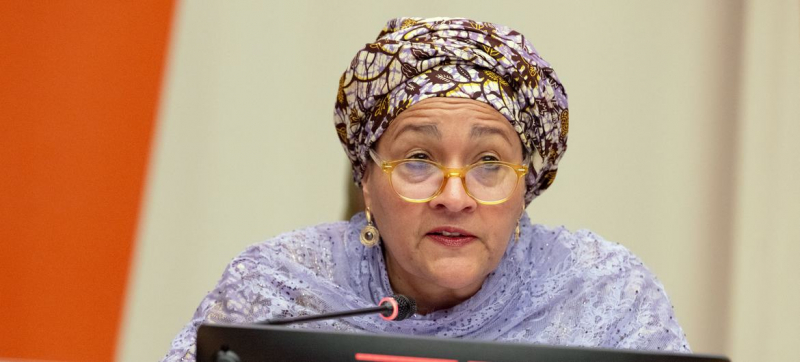

First Deputy Secretary General of the UN Amina Mohammed. The first UN Deputy Secretary General called for abandoning the principle of “he who is stronger is right” in international relations UN
Speaking in the Danish Parliament on Thursday, the UN Deputy Secretary-General said that the world is going through a period of dangerous turbulence, in which the foundations of the international order laid down in the UN Charter are under threat.
Amina Mohammed stressed that states are increasingly undermining the institutions they themselves built after the Second World War, and warned of the risk of “eroding the foundations” that have ensured decades of peace and development. The Deputy Secretary-General thanked Denmark for its continued support for multilateralism, calling the country a “humanitarian power” and one of the most consistent defenders of human rights. She noted that it is precisely such states that support the UN Charter today, when major powers are increasingly acting from a position of strength.
Threat to international law and the rise of “dangerous nostalgia”
In her speech, Mohammed recalled that threats to the sovereignty and territorial integrity of states have again become a reality and that some countries, “with dangerous nostalgia,” are trying to revise borders and rules based on force. She cited a speech by Kenyan Ambassador Martin Kimani, who warned of the risks of returning to the “logic of empires.” She said the UN Charter is “not a menu in a restaurant” and states cannot choose which norms to respect and which to ignore. Mohammed emphasized that it is small countries – such as South Africa or the Gambia – that today demonstrate the greatest integrity in defending international law.
Development as an investment in the world
The second part of the speech by the First Deputy Head of the UN was devoted to sustainable development. Mohammed recalled that over the past decades the world has made significant progress – from reducing poverty to reducing maternal mortality. However, geopolitical tensions and economic crises are leading to stagnation or even regression. Mohammed pointed to a sharp imbalance in global spending: in 2024, the total global military budget reached a record $2.7 trillion, while the annual Sustainable Development Goals funding gap stands at $4.2 trillion. “Money is flowing in the wrong direction,” she said, adding that growing inequality threatens stability around the world.
UN reform: restarting the system
The third key block of Amina Mohammed’s speech was the need to reform the United Nations itself. The Deputy Secretary General said that “the apparatus of international cooperation is outdated,” and its “software” has long been in need of a “reboot.” Mohammed spoke about the UN-80 initiative, which the Secretary-General brought to the table for discussion among member states. We are talking about a comprehensive modernization of the UN system – from the humanitarian block to the maintenance of peace and security – in order to make it more flexible and effective in the face of limited resources and growing challenges. “Countries are faced with problems that do not fit into separate categories. They are interconnected, and the decisions must be the same,” she emphasized. Concluding her speech, the Deputy Secretary General drew a historical parallel with Christiansborg – the Danish parliament building, which burned down twice and was rebuilt each time. “The UN, too, was born from the ashes to say ‘never again,’” she stressed. Today, she said, the world once again faces a choice: allow the principle of “might is right” to destroy the international order, or show political will and renew the system of multilateralism.