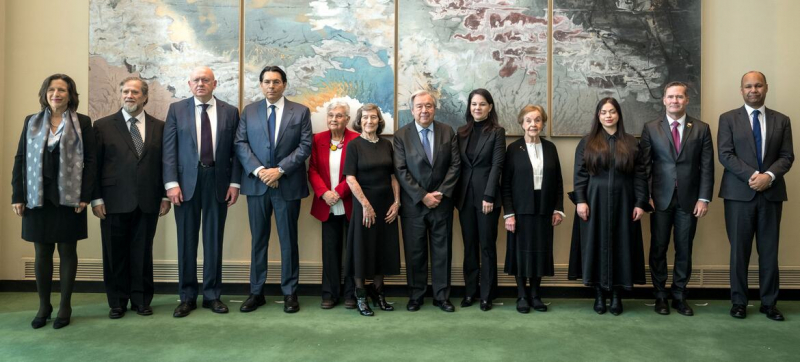

Natalia Tomenko (third from right) with UN Secretary-General Antonio Guterres (center) and other participants in the ceremony on International Holocaust Remembrance Day. Memory of the Roma genocide – from death camps to the UN podium Evgenia Kleshcheva Culture and education
This year, at a ceremony at UN headquarters dedicated to International Holocaust Remembrance Day, the testimony of a representative of the Roma people from Ukraine was heard for the first time. Activist and researcher of Roma heritage Natalia Tomenko brought a video message from her grandmother, a survivor of Nazi persecution, to New York. She spoke to UN News after the ceremony.
During the Second World War, the Nazi regime, its allies and collaborators systematically persecuted and exterminated the Roma people. According to UNESCO, about 500 thousand people may have been killed throughout Europe, although the exact number is difficult to determine: many victims were not registered and archives were destroyed.
According to information from the Memorial and Museum of Auschwitz-Birkenau, about 23 thousand Roma and Sinti were deported to this camp, of which approximately 21 thousand died from disease, exhaustion or were killed in gas chambers.
The symbol of this tragedy was the night of August 2, 1944, when the Nazis liquidated the so-called “Gypsy family camp” in Birkenau. Some 4,200–4,300 men, women and children were killed in the gas chambers. Today this date is recognized in many countries as the Day of Remembrance of the Victims of the Roma and Sinti Genocide.
The long-silent genocide
After the war, the Roma genocide remained in the shadows for decades. As UNESCO experts note, the Roma were not recognized for a long time as victims of Nazi racial persecution on an equal basis with other groups, and anti-Gypsy prejudices persisted in society.
Today, the Roma are the largest national minority in Europe, but still face racism and human rights violations. According to a recent survey of Roma in ten European countries, one in four respondents reported experiencing discrimination in various areas of life because of their ethnicity. In addition, one in five Roma children experience hate-related bullying and harassment at school.
Personal certificate
Today the memory is returning— and the voices of the Roma themselves are heard more and more often.
At the annual Holocaust Remembrance Day ceremony at the UN General Assembly in New York this year, the testimony of a Ukrainian Roma family was heard for the first time. Video message from Galina Tomenko, who was unable to fly in person due to her age and health condition, was introduced by her granddaughter, youth human rights activist and researcher of Roma cultural heritage, Natalia Tomenko.
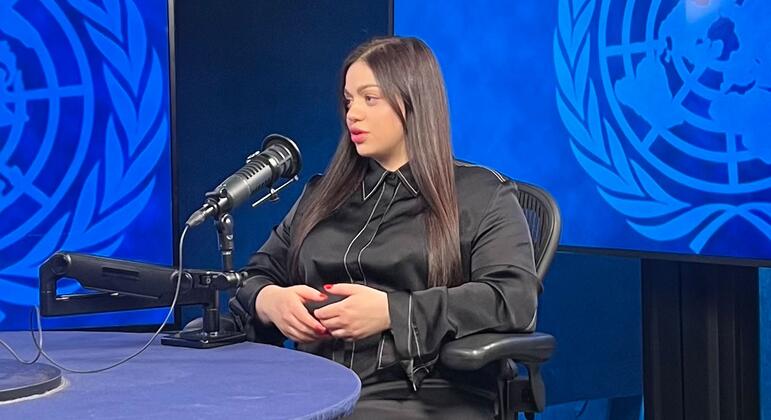
“Being here today and presenting my grandmother’s testimony is very personal to me. It is also a historic moment because it is the first time that a Ukrainian Roma testimony is presented at a UN ceremony commemorating the Holocaust,” she said in an interview with UN News Service.
According to her, the tragedy of the Ukrainian Roma had its own specifics. “In Ukraine, the Roma genocide was different… it happened “by bullets”: Roma were collected in certain places and destroyed—not in concentration camps, but in places of mass executions, including Babi Yar, Chernigov and many other cities,” Tomenko said.
Historians are still identifying such places. Many of them, as Natalia notes, are not marked. The youth organization ARKA, where she holds one of the leadership positions, records and preserves testimonies of survivors of the Roma genocide. Tomenko emphasizes that memory is not only pain, but also a source of strength: “This intergenerational trauma and also solidarity are now helping the Roma communities of Ukraine to survive and help the country.”
The memory of the Roma genocide today is actively supported by youth initiatives. In different regions of Ukraine, according to Tomenko, educational weeks, trainings, work with oral history are being held, and digital archives are being created. All this is aimed at ensuring that the Roma genocide ceases to be “forgotten”.
“Love conquers all”
Speaking about what is important to convey to world leaders, Natalia returns to the words of her grandparents who survived the war: “They always taught us to be human, to help others,” it doesn’t matter whether they are Roma or non-Roma. Love conquers all.”
The story of her grandfather occupies a special place in Natalia’s story. During the Nazi occupation of Kremenchug, his family tried to escape by crossing the bridge in a horse-drawn cart. The city changed hands, and the retreating Nazis set fire to everything around. According to Natalia, the SS noticed the Roma family – by appearance, by language – and were about to shoot them.
At that moment, a German officer appeared in a long leather coat, who, as the grandfather recalled, took his two-year-old child in his arms, showed him a photograph of his own son and gave the family a few minutes to escape. As soon as the cart left the bridge, it was blown up. “This story shaped my identity,” recalls Natalia. “My grandparents survived because someone showed humanity at the last moment. But they had to remain silent in order to survive. Our generation chooses a different way – to speak.”
The role of the UN and international structures
In recent years, international organizations have increased attention to this topic. To counter denial and distortion of the facts about the Roma genocide, UNESCO, together with the International Holocaust Remembrance Alliance, the European Commission, UN agencies and the OSCE Office for Democratic Institutions and Human Rights, is conducting a global digital campaign #ProtectTheFacts. It disseminates archival materials, testimonies of Roma victims and survivors, as well as historical information about the Roma genocide during the Second World War.
The UN Special Minority Rights Mechanisms call on states to formally recognize the Roma genocide, include it in educational programs and counter antigypsyism, a form of racism that remains widespread in Europe, according to the EU Agency for Fundamental Rights.